
TL;DR:
- Many athletes mistakenly believe that UV arm sleeves provide complete sun protection, but performance varies under sweat and heat. UPF 50+ sleeves block about 98% of UV rays when new and correctly fitted, yet their effectiveness diminishes with stretching, wetness, and wear over time. Proper selection, maintenance, and usage as part of a layered heat safety plan are essential for genuine outdoor protection.
Most athletes assume that pulling on a UV arm sleeve means they’re protected from the sun, no matter the conditions. That assumption can leave you badly burned or dangerously overheated. The reality is more layered: not every sleeve performs the same way once sweat, stretching, and brutal Aussie heat enter the picture. In this article, we break down the science of UPF ratings, expose the limits of “cooling” claims, and give you a clear, practical framework for choosing sleeves that genuinely protect you when it counts most.
Table of Contents
-
The realities of extreme heat: Do UV sleeves keep you cool and safe?
-
What most athletes get wrong about UV arm sleeves in extreme heat
-
Find high-performing UV protection and gear for training outdoors
Key Takeaways
| Point | Details |
|---|---|
| Certified UPF is vital | Choose genuine UPF 50+ sleeves for reliable sun protection during long outdoor activities. |
| Real-world factors matter | Sweat, stretching, and washing significantly reduce sleeve effectiveness, so maintain your gear carefully. |
| Cooling claims are limited | Sleeves may help with moisture-wicking but are no substitute for hydration and proper heat management strategies. |
| Smart selection improves safety | Prioritise fit, breathability, and label-backed protection to ensure UV sleeves actually work in harsh Aussie conditions. |
How do UV arm sleeves block harmful rays?
To understand whether a sleeve actually works, you first need to know what the label means. UPF stands for Ultraviolet Protection Factor. It measures how much UV radiation, both UVA and UVB, a fabric blocks before it reaches your skin. Think of it as SPF for clothing, but more thorough, because it accounts for both types of damaging rays.
The gold standard in protective apparel is UPF 50+. As Cleveland Clinic explains, UPF 50+ clothing blocks roughly 98% of UV radiation, meaning no more than 2% passes through to your skin. By comparison, a plain white cotton t-shirt may only offer UPF 5 to 10, letting through 10 to 20 times more UV than a certified sleeve.
Here’s how common UPF ratings stack up:
| UPF rating | UV radiation blocked | UV radiation reaching skin |
|---|---|---|
| UPF 15 | 93.3% | 6.7% |
| UPF 30 | 96.7% | 3.3% |
| UPF 50 | 98.0% | 2.0% |
| UPF 50+ | 98%+ | Under 2% |
| Plain cotton t-shirt | ~80% | ~20% |
“UPF clothing can meaningfully reduce UV exposure compared with ordinary clothing because it is designed to block most UV; UPF 50+ means at most about 2% of UV passes through, compared to far higher rates in standard fabrics.”
The key word is designed. A sleeve earns its UPF 50+ rating through specific weave density, fibre type, and in many cases added UV-absorbing chemicals in the fabric. Loose weaves, thin fabrics, and standard athletic compression sleeves are not the same thing. Understanding UPF 50 clothing helps you separate genuine sun protection from marketing language. When you are training outdoors or competing in a combat sport under direct sun, that difference is not trivial. It is the difference between real protection and a false sense of security.
Knowing how to spot quality UV protection in a garment before you buy saves you from discovering its shortcomings mid-session.
The realities of extreme heat: Do UV sleeves keep you cool and safe?
Here is where things get genuinely complicated. A sleeve can carry a legitimate UPF 50+ rating and still underperform in real training conditions. Two factors drive this: changes in the fabric under stress, and overstated “cooling” claims.
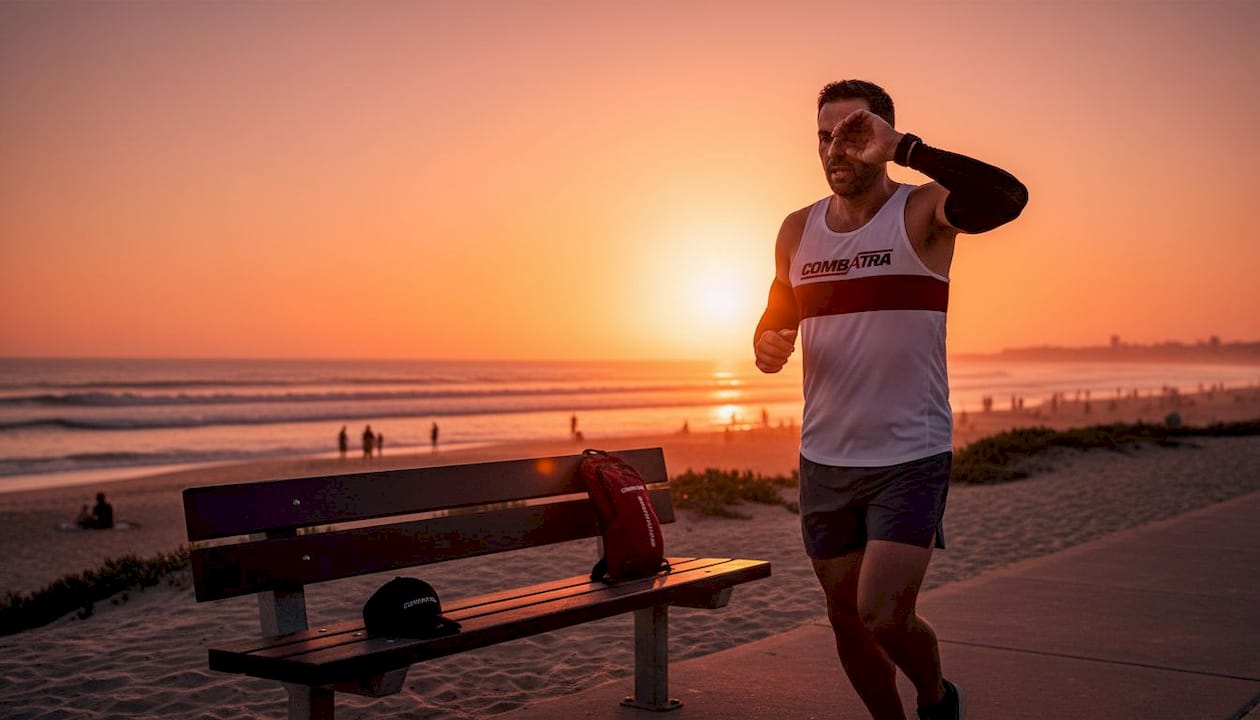
Fit and stretch matter more than most athletes realise. As REI’s expert guidance points out, sleeve fabric performance is most reliable when the garment stays within the conditions assumed by its UPF rating, meaning no excessive stretching and no significant fabric degradation. When a sleeve is pulled too tightly across the forearm or shoulder, the weave opens up, and more UV slips through. This is a common issue for BJJ practitioners, MMA athletes, and anyone whose sleeves get yanked or compressed against training partners.
Sweat adds another variable. When fabric becomes saturated, its behaviour changes. Some materials lose protective density when wet, while others maintain or slightly improve their UV block. Unless a sleeve is specifically tested under wet conditions, you simply do not know which category it falls into.
Now for the bigger myth: the idea that arm sleeves keep you cool in extreme heat.
Research on wearable cooling garments shows that cooling from sleeves in hot conditions is plausible mainly through moisture-wicking and evaporative cooling, not through any temperature-lowering magic. The fabric draws sweat away from your skin, that sweat evaporates, and you feel slightly cooler. But this effect varies widely depending on humidity, air flow, and how hard you are working. Critically, evaporative cooling from a sleeve does not reliably reduce your core body temperature, which is what matters when it comes to heat illness.
What UV arm sleeves can and cannot do in extreme heat:
-
Can do: Block the majority of UV radiation when correctly fitted and in good condition
-
Can do: Wick sweat away from the skin surface and support surface-level cooling
-
Can do: Reduce the risk of sunburn and long-term UV skin damage during prolonged outdoor exposure
-
Cannot do: Prevent heatstroke or reliably lower your core body temperature
-
Cannot do: Maintain full UPF rating when excessively stretched, soaked, or worn out
-
Cannot do: Replace shade, hydration, and rest as primary heat safety strategies
Pro Tip: When evaluating a sleeve for hot weather training, prioritise moisture-wicking and breathable fabrics confirmed with actual UPF 50+ certification. Do not let “cooling” marketing on the label convince you that the sleeve substitutes for a solid heat management plan.
Understanding how UV clothing works at a fabric level helps you make smarter choices at purchase rather than guessing. The comparison between UPF clothing and sunscreen is also worth reviewing, especially for athletes who sweat heavily and find sunscreen unreliable after an hour of training.
Factors that reduce real UV protection in the field
Even a high-quality sleeve starts losing ground once you put it to work consistently. The rated UPF is measured under controlled, static, dry laboratory conditions. Field conditions are the opposite of that. Here is how the gap between label and reality widens over time.
Research confirms that wetting, stretching, and washing can meaningfully reduce a textile’s effective UPF, and that relying solely on dry lab testing can significantly overestimate real-world performance. This is a critical point for athletes who train daily.
Here is a practical comparison between a fresh sleeve and a worn one:
| Condition | Expected UPF | Real-world UPF | Risk level |
|---|---|---|---|
| New sleeve, dry, correct fit | 50+ | 48 to 50+ | Low |
| New sleeve, wet (sweaty) | 50+ | 35 to 48 | Moderate |
| New sleeve, overstretched | 50+ | 20 to 40 | Moderate to high |
| Worn sleeve after 50+ washes | 50+ | 15 to 30 | High |
| Worn, wet, and stretched | 50+ | Under 20 | Very high |
The top factors that degrade sleeve effectiveness are:
-
Excessive stretching: Pulls the weave apart, creating larger gaps for UV to penetrate
-
Prolonged sweat saturation: Changes fibre density and can accelerate wear over time
-
Incorrect washing: Hot water, harsh detergents, and tumble drying break down UV-absorbing finishes
-
Physical abrasion: Grappling, ground contact, and friction against mats or rough surfaces thin the fabric
-
Prolonged direct sun exposure: Repeated UV exposure itself degrades certain fabric treatments over time
-
Poor fit from the start: A sleeve that bunches, sags, or requires constant adjustment will stretch in the wrong places
Checking guidance on choosing UV clothing for all-day sport gives you a framework for evaluating both construction quality and durability before committing.
Pro Tip: Read your sleeve’s care label before the first wash. Many high-performance UV garments require cold water, gentle cycle, and air drying to preserve their protective finish. Following these instructions is not optional if you want the sleeve to perform on day 200 the way it did on day one.
For broader guidance on maintaining performance gear through Aussie summers, summer apparel care advice provides a useful reference for anyone spending extended time outdoors in heat-intensive conditions.
How to choose UV arm sleeves for harsh Aussie conditions
Armed with the science and the pitfalls, you can now make a genuinely informed choice. The Wirecutter’s research on effective sun protection clothing is clear: UV protection from sleeves is most credible when the sleeve carries a genuine UPF 50+ rating that is independently certified, stays in place without excessive stretching during activity, and is maintained correctly so its UV-blocking properties remain intact over time.
Here is what to look for when selecting UV arm sleeves for combat sports or extended outdoor training in Australia:
-
Certified UPF 50+ rating: Look for independent certification, not generic “sun protection” claims. The tag should state the UPF rating explicitly.
-
Fabric composition: Polyester and nylon blends with tight weave construction generally hold their UPF better than loosely woven cotton or generic lycra.
-
Moisture management: Choose fabrics with confirmed wicking properties so sweat moves away from your skin rather than saturating the sleeve.
-
Fit without overstretching: The sleeve should sit snugly without requiring you to pull it taut. If it feels tight at its widest point, go a size up.
-
Seam and edge construction: Flat-lock seams reduce friction and prevent edge lifting during grappling or ground work, which maintains coverage.
-
Care instructions that match your lifestyle: If you train daily, you need a sleeve that survives frequent washing without losing its protective properties.
-
Replaceable on a schedule: Even the best sleeve has a lifespan. If you train hard several times a week, plan to replace sleeves every six to twelve months depending on visible wear.
More detailed guidance on choosing UV arm sleeves for sports and outdoor training walks through these criteria in the context of specific activities, which helps you prioritise what matters most for your training environment.
For athletes and outdoor workers spending long days in Queensland or Western Australian sun, gear engineered for conditions like those found in extreme heat environments offers a useful benchmark for what purpose-built UV apparel should deliver.
What most athletes get wrong about UV arm sleeves in extreme heat
Here is the uncomfortable truth we rarely say directly: most athletes who wear UV arm sleeves are treating them as a complete solution rather than one layer of a broader strategy.
The instinct is understandable. You buy a sleeve with UPF 50+ printed on it, you put it on, and you feel covered. But what that sleeve is doing is protecting your skin from UV radiation when it is correctly fitted, in good condition, and not excessively wet or stretched. What it is not doing is keeping you safe from heat illness.
As medical expert commentary on wearable cooling devices confirms, you should not treat cooling sleeves as heatstroke prevention. Shade, hydration, rest breaks, and gradual heat acclimation are the interventions that genuinely protect your core temperature. Wearable cooling products, including sleeves, show mixed results for core temperature outcomes and work best as an adjunct to these fundamentals.
We have seen athletes train through extreme Aussie heat wearing premium sleeves and still end up with heat exhaustion, because they stopped drinking water regularly, skipped shade breaks, and mistook surface-level comfort for safety. The sleeve felt cool. The core temperature was climbing regardless.
The smarter approach is to think of your UV sleeve as one tool in a layered system. It handles the sun damage risk. Hydration, shade, timed breaks, and gradual heat adaptation handle the heat illness risk. Neither replaces the other.
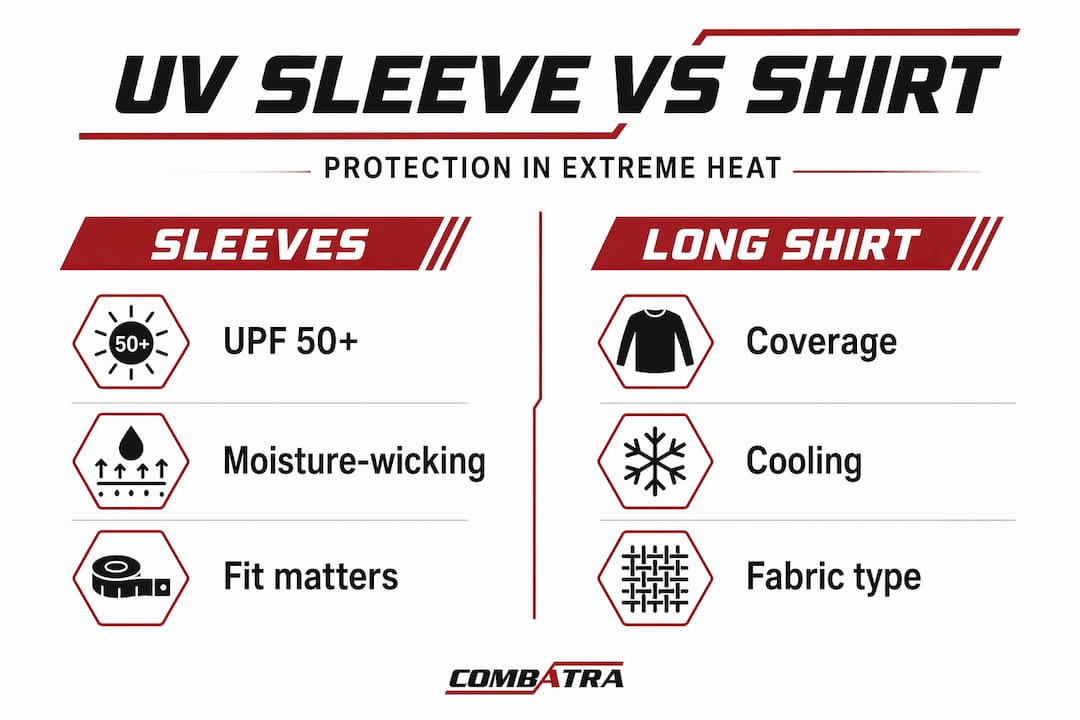
Comparing sleeves versus long-sleeve shirts for sun protection is also worth understanding because the choice between them affects ventilation, mobility, and overall heat load during intense activity.
The most effective athletes we see using UV protection gear well are not the ones with the most expensive kit. They are the ones who understand what each piece of gear actually does, and they plan their heat strategy around real physiology rather than label promises.
Find high-performing UV protection and gear for training outdoors
If this guide has changed how you think about UV sleeve performance, the next step is finding gear that matches these standards rather than just marketing them.
At Combatra, every piece of UV protection gear is built for athletes who train in real conditions, not lab settings. Our rashguards for sun protection are engineered with certified UPF 50+ fabrics, moisture management, and combat-specific construction that holds up through grappling, drilling, and long outdoor sessions. If you want a foundation layer that genuinely blocks UV and moves with you, the compression rashguard is purpose-built for exactly these demands. You can also personalise it with your academy name, colours, or logo to build team-wide UV protection standards.
Frequently asked questions
Does wet or stretched fabric reduce the UV protection of arm sleeves?
Yes, sweat, water, and stretching can all reduce a sleeve’s actual UPF rating in real use, meaning less UV is blocked compared to the dry lab conditions under which it was tested.
Are UV arm sleeves effective for preventing heatstroke?
No, arm sleeves cannot prevent heatstroke on their own. As medical research confirms, core heat safety depends on shade, hydration, rest breaks, and heat acclimation, not wearable cooling products alone.
How long do UV protection sleeves last before losing effectiveness?
Protection can degrade after repeated wear, washing, stretching, and UV exposure. Research shows UPF values change with use, so replace sleeves when the fabric looks thin or worn, or when fit becomes unreliable.
What’s the difference between a UPF-rated sleeve and regular compression sleeves?
UPF-rated sleeves are independently tested to block UV radiation, with UPF 50+ blocking 98% of UV rays. Regular compression sleeves offer muscle support but carry no certified sun protection unless explicitly rated.