
TL;DR:
- UPF clothing provides a reliable, continuous barrier against UV radiation, especially important in Australia’s high UV environment for active individuals. It remains effective despite sweating, water, or movement, unlike sunscreen that requires frequent reapplication and can degrade under real-world conditions. Combining UPF-rated garments with proper sunscreen use offers the most comprehensive sun protection during outdoor sports and activities.
Even the most diligent sunscreen users can miss up to 10% of their skin during application, and that protection starts degrading the moment you begin to sweat. For Australian athletes, martial artists, and outdoor enthusiasts spending hours under one of the world’s harshest UV environments, that gap is not trivial. Sunscreen effectiveness depends heavily on correct application and timely reapplication, and no sunscreen blocks 100% of UV radiation. UPF-rated clothing offers something sunscreen simply cannot: a continuous, reliable barrier that works without you thinking about it.
Table of Contents
-
Sunscreen vs UPF clothing: real-world comparison for athletes and outdoor lovers
-
Are there any downsides? The limits of UPF clothing for full sun safety
-
What most Aussies get wrong about sun protection during sport
-
Ready for real protection? Quality UPF gear for active Australians
Key Takeaways
| Point | Details |
|---|---|
| UPF beats sunscreen for coverage | UPF clothing provides reliable, continuous sun protection for the skin it covers, outperforming sunscreen in real-world use. |
| Layer both for full safety | The best approach is to combine UPF-rated gear with sunscreen on exposed skin for complete protection. |
| Choose certified gear | Always select clothing with a verified UPF rating under AS/NZS 4399:2020 to ensure it actually blocks harmful UV. |
| Fit and condition matter | Wear snug, undamaged, and dry UPF clothing for the highest protection, as stretch or wetness reduces its effectiveness. |
| UPF is hassle free | UPF sports gear protects you without constant reapplication—perfect for intense or long-duration outdoor activities. |
What makes Australian sun protection uniquely challenging
To understand why traditional protection methods often disappoint, let’s look at what makes the Australian sun so formidable.
Australia sits in one of the highest UV zones on the planet. The UV index regularly reaches 11 or above during summer, which is classified as extreme. At these levels, unprotected skin can begin to burn in as little as 10 minutes. That is a short window for anyone outdoors, let alone an athlete mid-session on a BJJ mat set up outside, a surfer paddling out, or a trail runner pushing through midday heat.
The problem is not just intensity. It is duration and movement. Athletes and outdoor workers are often out in the sun for hours at a stretch, moving constantly, sweating heavily, and focused entirely on performance rather than sun safety. These real-world conditions are where sunscreen strategies start to crack.
Here is what typically goes wrong:
-
Missed spots: Studies consistently show that people apply sunscreen to roughly 50 to 75% of the body surface area that needs coverage, leaving patches of completely unprotected skin.
-
Sweat and water degradation: Even water-resistant sunscreens lose significant protection after swimming, heavy sweating, or towel drying.
-
Delayed reapplication: The recommended reapplication window is every two hours, but during a two-hour training session or bushwalk, most people do not stop to reapply once.
-
Movement and rubbing: Contact sports, tight gear, and repetitive movement rub sunscreen off the most sun-exposed areas faster than most people realise.
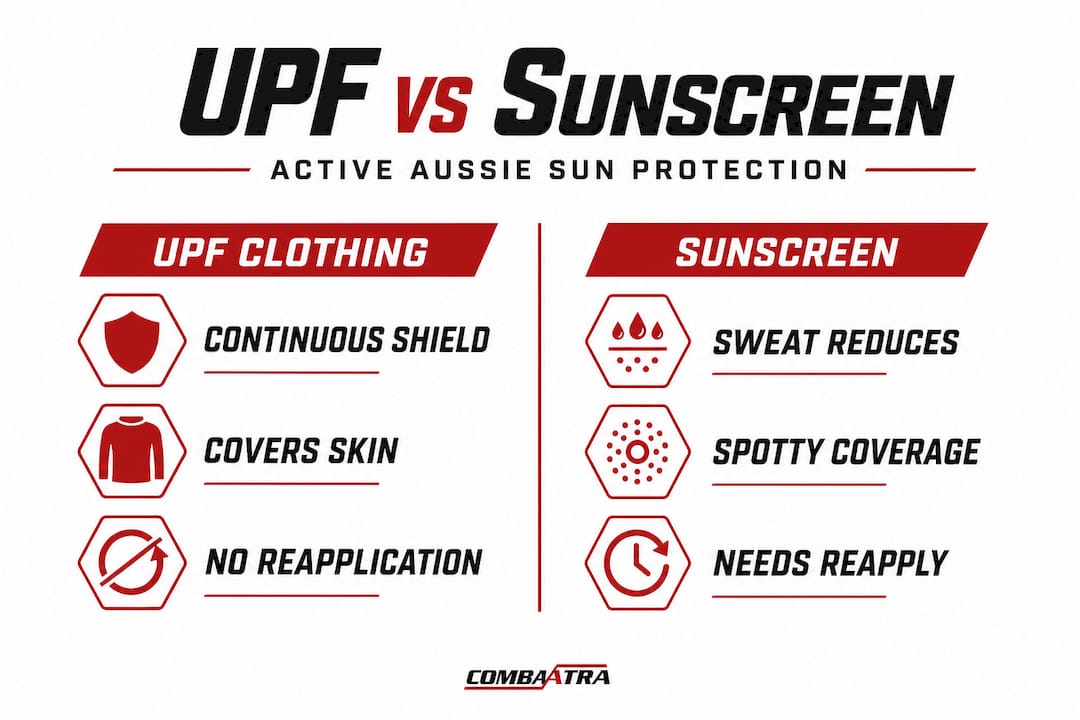
“For athletes and outdoor enthusiasts in Australia, sunscreen-only strategies often fail in practice because protection is reduced by missed spots, and sunscreen needs reapplication and can be affected by exercise, sweat, and water, whereas UPF clothing is designed to provide continuous protection while worn.”
This is not a reason to abandon sunscreen entirely. It is a reason to take a smarter, layered approach. Understanding preventing sunburn outdoors starts with recognising that sunscreen alone was never designed to carry the full load for active lifestyles.
UPF clothing: how it works and why experts trust it
Given these dangers, let’s explore why UPF clothing is trusted by experts as a superior form of sun protection for active Australians.
UPF stands for Ultraviolet Protection Factor. Think of it as an SPF rating, but for fabric. It measures how much UV radiation passes through a garment and reaches the skin underneath. A UPF 50+ rating means the fabric blocks at least 98% of UV radiation on the skin it covers. That is both consistent and immediate. You put the garment on, and you are protected.
In Australia, that rating is not just a marketing claim. It is governed by Australian Standard AS/NZS 4399:2020, which tests garments for UV transmittance when fabric is dry and unstretched. This standard gives you a verified benchmark that unverified labels like “UV safe” or “sun-resistant” simply cannot match.
| Protection method | Coverage consistency | Needs reapplication | Australian standard | Effective while sweating |
|---|---|---|---|---|
| SPF 50+ sunscreen | Variable (user-dependent) | Yes, every 2 hours | No | Reduced |
| UPF 50+ clothing | Consistent (on covered skin) | No | Yes (AS/NZS 4399) | Yes |
| Unrated clothing | Unpredictable | No | No | Yes |
The contrast is clear. UPF 50 clothing offers a level of certainty that sunscreen cannot match for covered areas. It physically blocks UV rather than relying on a chemical or physical filter that must be renewed regularly.
“In Australia, sun-protective clothing rated UPF 50/50+ is a more reliable first-line barrier than sunscreen for the skin it covers, because it physically blocks UV continuously rather than relying on reapplication and even spreading on skin.”
When you are looking for spotting high-quality UPF gear, the label matters enormously. Verified UPF garments are tested under conditions that reflect real use, not ideal use.
Pro Tip: Always check that a garment lists its UPF rating numerically (UPF 50 or UPF 50+) and references AS/NZS 4399:2020. If neither appears on the label or product page, the protection claim is unverified and should be treated with scepticism.
Sunscreen vs UPF clothing: real-world comparison for athletes and outdoor lovers
Now that we’ve covered what UPF means, let’s compare how UPF clothing and sunscreen stack up in practical, real-life scenarios.
Picture this: a martial artist heading to an outdoor BJJ session at 9am. They apply SPF 50+ sunscreen before leaving home. By the time they finish warm-ups 30 minutes later, they have sweated through the sunscreen on their arms and shoulders. By the one-hour mark, the areas most exposed to the sun have lost meaningful protection. This scenario plays out every single day for active Australians, and it is not a failure of the sunscreen product. It is a failure of the strategy.
“Sunscreen-only approaches often fail in practice for athletes because protection is reduced by missed spots and because it needs reapplication, and can be affected by exercise, sweat, and water, whereas UPF clothing is designed to provide continuous protection while worn.”
Here is a practical side-by-side comparison of how each method holds up during a two-hour outdoor training session:
| Scenario | Sunscreen only | UPF 50+ clothing |
|---|---|---|
| After 30 minutes of exercise | Reduced by sweat | Still fully effective |
| After water contact (surfing, swimming) | Significantly reduced | Minimal impact |
| During grappling or contact sport | Rubbed off by contact | Unaffected |
| Full body coverage | User-dependent | Depends on garment coverage |
| Remembering to reapply | Often forgotten mid-session | Not required |
The advantages of UPF clothing during active training are consistent and clear. But it is equally important to understand what UPF clothing does not do. As Cancer Council Australia notes, UPF clothing is best thought of as “sunscreen in fabric form” for the body areas it covers. Sunscreen is still essential for skin the clothing does not reach.
Here is a practical layering strategy for maximum protection during long outdoor sessions:
-
Start with UPF 50+ clothing covering your torso, arms, and legs wherever possible.
-
Apply SPF 50+ sunscreen to all exposed skin, including your face, neck, hands, and feet.
-
Reapply sunscreen every two hours to uncovered areas, even if it feels unnecessary.
-
Seek shade during peak UV hours, typically 10am to 3pm.
-
Wear a broad-brimmed hat and UV-blocking sunglasses for added facial and eye protection.
This layered approach is what sunsmart training looks like in practice. It is not a choice between sunscreen and UPF clothing. It is using both where each works best.
Pro Tip: If you are building your UV-safe training outfit, prioritise long-sleeve rashguards and full-length compression tights over sun shirts that leave the shoulders and arms exposed. Coverage area is everything. You can also explore the best sun protective clothing options designed specifically for outdoor training sessions.
Are there any downsides? The limits of UPF clothing for full sun safety
Even the best protective gear has its limits. Let’s look at the practical boundaries of relying solely on UPF clothing.
UPF 50+ clothing blocks 98% of UV on the skin it covers. That is outstanding protection, but it is not 100%. And in practice, real-world effectiveness can be lower than the laboratory rating for several reasons.
| Factor | Effect on UPF performance |
|---|---|
| Fabric stretched during movement | Weave opens, more UV passes through |
| Wet fabric (sweat or water) | Some fabrics transmit more UV when wet |
| Worn or damaged garments | Fibre degradation reduces UV blocking |
| Poor fit (too loose or too tight) | Reduces or compromises coverage |
| Low-coverage garment styles | Leaves more skin unprotected |
Research highlights that real-world UV exposure during prolonged outdoor activity can still be significant even when wearing garments, because transmitted UV depends on garment properties and specific exposure conditions. This is why experts caution against treating any single method as a complete solution.
Here are the key limitations to keep in mind:
-
UPF clothing only protects the skin directly underneath it. Necklines, armholes, and hem edges all create exposure zones.
-
Older garments that have been through many wash cycles may have degraded UV-blocking fibres.
-
Very lightweight or loosely woven fabrics may not reach UPF 50+ even if marketed with vague sun-protection claims.
-
In extremely high UV environments, even UPF 50+ clothing may not be sufficient as a standalone measure for very long exposures.
For hikers and trail runners spending full days outdoors, understanding the real limits of UV protection for hikers is critical. The goal is always layered, consistent protection, not a single fix.
How to choose and use UPF clothing for maximum sun defence
So, how do you ensure your sun protection setup is bulletproof? Here is a step-by-step game plan for maximum defence.
Choosing the right UPF clothing is straightforward once you know what to look for. The challenge is cutting through marketing language and finding garments that actually deliver verified protection.
-
Check for UPF 50 or UPF 50+ ratings. Any garment claiming UV protection should display a specific UPF number, not vague language like “UV resistant.”
-
Look for AS/NZS 4399:2020 compliance. This is the Australian and New Zealand standard that governs UPF ratings. Its presence on a label confirms third-party testing has occurred.
-
Prioritise coverage. Long sleeves, high necks, and longer leg coverage protect far more surface area than sleeveless or cropped designs.
-
Check fit carefully. A well-fitting garment should be snug without stretching the fabric significantly. Overstretched fabric allows more UV through the weave.
-
Inspect regularly. Replace garments that show signs of heavy wear, fading, or fabric thinning, as these reduce UV-blocking effectiveness.
-
Apply sunscreen to uncovered areas. As Cancer Council Australia advises, sunscreen remains essential for your face, hands, and feet, as well as any skin exposed by the garment’s cut.
When picking quality UPF gear, prioritise brands that provide testing documentation or garment-specific UPF data rather than general claims. And if you are planning your full summer training wardrobe, think through your UV protective summer outfits as a complete system, not individual pieces.
Pro Tip: Darker colours and more tightly woven fabrics generally offer higher UPF ratings than light, loosely woven alternatives. If you are choosing between two garments with similar coverage, the denser fabric wins for UV protection.
What most Aussies get wrong about sun protection during sport
With the facts in hand, let’s shift to a candid perspective that rarely gets discussed outside athletic circles.
Here is the uncomfortable reality: Australia has run sun safety awareness campaigns for decades, and most athletes already know they should reapply sunscreen every two hours and wear protective clothing. The knowledge is not the problem. The behaviour is.
When you are three sets into a hard sparring session, or an hour into a trail run, or mid-heat at a weekend surf competition, sun protection is not on your mind. It is genuinely the last thing you are thinking about. And this is not a personal failing. It is simply how performance states work. Your focus narrows to the task, and maintenance habits collapse under that pressure.
This is why the practical advantage of UPF clothing is time-and-behaviour independence: you do not have to remember reapplication mid-session, which is a major failure mode of sunscreen use during exercise. The protection is either on or off based on whether you are wearing the garment, not whether you remembered to reapply at the 90-minute mark.
What we would push back on is the framing that UPF clothing and sunscreen are competing strategies. The most effective athletes we see in training are not choosing one over the other. They wear well-fitted UPF rashguards and tights to protect the bulk of their skin, apply sunscreen to uncovered areas before they start, and reapply sunscreen to those same uncovered areas at breaks. That is not a complicated system. It takes about three minutes of additional preparation.
The athletes who struggle most with sun protection are those who rely entirely on sunscreen and treat any gear they happen to be wearing as bonus protection. The UPF vs sunscreen debate is real, but the answer is not either/or. The answer is always: use UPF clothing as your primary defence on covered skin, and sunscreen for everything else.
Ready for real protection? Quality UPF gear for active Australians
If you’re ready to upgrade your sport protection, choosing gear specifically rated for UPF is your next move.
At Combatra, we build performance sportswear with UPF 50+ protection that is designed for real training conditions, not laboratory assumptions. Our garments are built to stay effective through sweat, grappling, extended outdoor sessions, and repeated washing.

Whether you train in BJJ, Karate, MMA, or simply spend long hours outdoors, we have purpose-built options to cover you. Our UPF rashguards combine certified sun protection with the compression and flexibility that active athletes need. You can also personalise your gear with your name, team logo, or academy colours, making Combatra ideal for both individual athletes and full squads. Sun safety and performance do not have to be a compromise. We build gear where both coexist.
Frequently asked questions
Can UPF clothing replace sunscreen for all activities?
No. UPF clothing protects only the skin it covers, so you will still need sunscreen for exposed areas like your face, hands, and feet. UPF clothing is best thought of as sunscreen in fabric form, not a full replacement.
How do I know if UPF clothing meets Australian standards?
Check the label for a specific UPF rating, preferably UPF 50+, and a reference to AS/NZS 4399:2020 for verified, standardised protection.
Is regular clothing as protective as UPF-rated clothing?
No. Regular, non-certified clothing can have highly unpredictable UV protection, with UPF values ranging from UPF 5 to over 400 depending on fabric type, weave, and colour. Only certified garments guarantee consistent protection.
Do I need to wear sunscreen under UPF clothing?
Sunscreen is not generally required under well-made UPF 50+ clothing, but it remains essential for any skin the garment does not cover, including low-coverage styles or areas at the edges of garments.
Does wet or stretched UPF clothing still protect well?
UPF effectiveness can drop when garments are wet or stretched significantly, since the UPF rating applies to fabric that is dry and unstretched. Always wear well-fitting garments in good condition for best results.