
TL;DR:
- Ordering custom martial arts uniforms requires early preparation, including detailed artwork, accurate in-person sizing, and supplier research. It is essential to start the process at least 10 to 12 weeks before the season to ensure timely delivery and proper fitting. Thorough inspection upon arrival helps address any defects promptly, maintaining team readiness and professionalism.
Ordering custom martial arts uniforms for your team is a coordinated process that combines design preparation, accurate sizing, supplier selection, and logistics management to produce cohesive, professional apparel that strengthens team identity and performance. In combat sports such as Brazilian Jiu-Jitsu, Karate, and MMA, a well-fitted uniform does more than look the part. It provides compression support, manages sweat during hard training rounds, and resists abrasion through repeated grappling contact. For Australian teams training outdoors or during summer months, fabric choice matters even more. Australia's UV index regularly reaches extreme levels, making UPF 50+ rated materials, tested to AS 4399:2020, a practical consideration for any rashguard or uniform worn outside. This guide walks martial arts instructors and team managers through every stage of the custom uniform ordering process, from brief preparation to post-delivery inspection.
How to order custom martial arts uniforms: what to prepare first
Before you contact any supplier, your preparation determines how smoothly the entire order runs. A clear, detailed brief with ready artwork is the single most effective way to reduce back-and-forth communication and accelerate production timelines. Coaches who arrive at the ordering stage without confirmed artwork, sizing data, or a defined budget routinely experience delays of one to two weeks before production even begins.
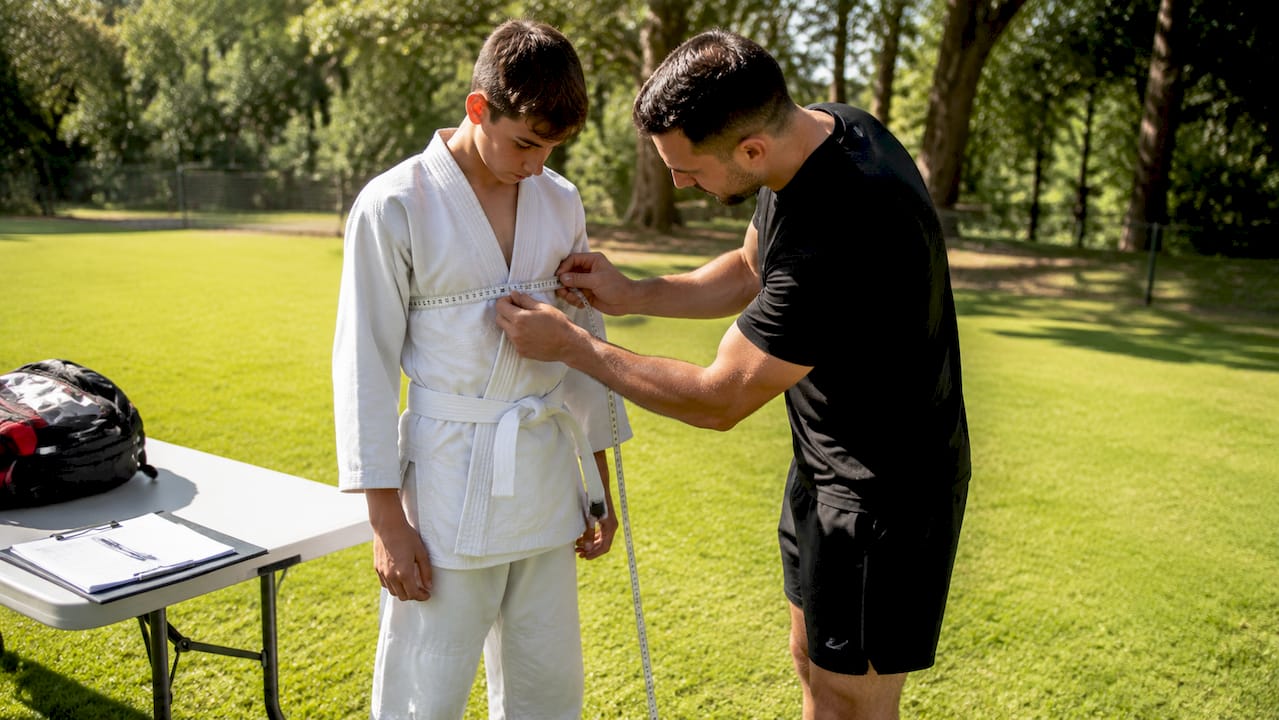
Start by confirming your roster count, then add a buffer. Order 2 to 4 extra uniforms beyond your active roster to cover size exchanges, new members, or mid-season replacements. This small upfront cost prevents the much larger problem of a player missing a competition because their replacement uniform is still in production.
Your artwork files must be in professional vector formats. Vector files such as .EPS or .AI are mandatory for quality results. Raster images, including JPEGs and PNGs, cause scaling issues and often trigger additional art fees from suppliers. If your dojo logo only exists as a low-resolution PNG, commission a vector redraw before you approach any supplier.
Here is a preparation checklist to complete before placing any order:
- Roster count plus buffer: Confirm active members and add 2 to 4 extras
- Artwork files: Obtain .EPS or .AI vector files for all logos and crests
- Colour references: Specify exact Pantone codes or standard colour references, not approximate descriptions like "navy blue"
- Fabric and fit preferences: Decide on weight, weave, and cut style relevant to your discipline (e.g., 10 oz vs 14 oz for Karate gis)
- Budget ceiling: Set a per-unit and total budget before requesting quotes
- Sport-specific requirements: Check competition regulations for uniform specifications, including colour restrictions and logo placement rules
Pro Tip: Create a one-page order brief document that consolidates all of the above. Share this with every supplier you approach for quotes. It signals professionalism and typically results in faster, more accurate proposals.
How do you collect accurate sizing from your team?
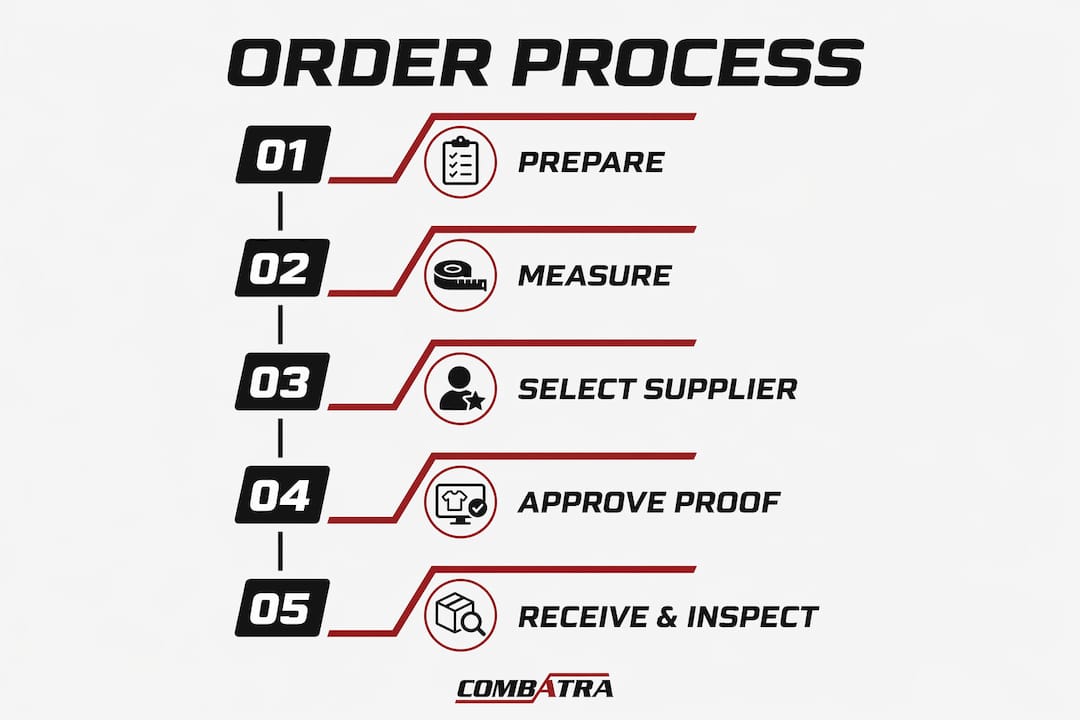
Self-reported sizing is unreliable, particularly among youth athletes. Accurate sizing data collected at practice is the most dependable method, and it prevents the costly problem of receiving a full order where 20% of uniforms do not fit correctly.
Run a dedicated measurement session at your next training night. You need five measurements per athlete: chest circumference, waist circumference, hip circumference, height, and weight. These five data points allow you to cross-reference any supplier's sizing chart accurately, rather than guessing between a medium and a large based on a t-shirt size.
Follow this process for a smooth measurement session:
- Prepare a spreadsheet in advance with columns for each measurement and a row for each athlete. Include a column for the athlete's preferred fit style (fitted vs. relaxed) if your supplier offers both.
- Use a flexible tape measure and measure over training clothes, not street clothes, since athletes will wear the uniform over similar layers.
- Record measurements in centimetres to match most Australian and international supplier sizing charts.
- Map each athlete's measurements to the supplier's size chart individually. Do not assume that a 180 cm adult and a 180 cm teenager wear the same size.
- Separate youth and adult sizing categories and confirm with your supplier whether they use different size scales for each.
- Flag any athletes near a size boundary and order the larger size. A uniform that is slightly generous is far easier to train in than one that restricts movement.
Pro Tip: Save your team's measurement spreadsheet after each order. Update it at the start of every season. This sizing database removes the need to re-measure the entire squad each time you place a new order and makes reorders significantly faster.
What should you look for when selecting a supplier?
Supplier selection determines your uniform quality, production speed, and the overall experience of managing the order. The right supplier for a 12-person Karate dojo is not necessarily the right supplier for a 60-person BJJ academy. Evaluate each option against the criteria that matter most to your team.
Many specialised martial arts apparel suppliers have no minimum order requirements, which suits smaller clubs that cannot commit to large bulk quantities. This flexibility is worth confirming early, as some general sportswear manufacturers impose minimums of 20 to 50 units per style.
| Criteria | What to confirm |
|---|---|
| Minimum order quantity | Can they fulfil your team size without excess? |
| Production timeline | Standard lead time is 2 to 4 weeks after design approval |
| Customisation options | Embroidery, sublimation printing, private labels, name and number placement |
| Digital proof process | Do they provide a digital mockup before production begins? |
| Shipping timeline | Confirm separately from production time; both add to total lead time |
| Communication responsiveness | Test response time before committing to an order |
One ordering method worth considering is a direct-to-athlete team shop. Centralised team shop platforms like those used by BSN Sports Club Direct or GearUP enable athletes to order and pay directly, removing the administrative burden from the coach entirely. This model works particularly well for large academies where collecting individual payments and sizes manually becomes a significant time cost.
Before approving production, request a digital proof that shows logo placement, name and number styles, and colour accuracy. Verify every detail against your original brief. Once production begins, changes are expensive and time-consuming.
How do you manage delivery and check quality on arrival?
Proactive tracking and thorough inspection on arrival protect you from discovering problems too late to resolve them before your season starts. Confirm production and shipment dates in writing at the time of order, and track your shipment actively rather than waiting for it to appear at your door.
When the order arrives, inspect every item before distributing anything to athletes. Work through this checklist systematically:
- Quantity check: Count every item and verify it matches your order confirmation
- Size accuracy: Cross-reference each uniform against your sizing spreadsheet
- Print and embroidery quality: Check for clean edges, correct colours, and no bleeding or misalignment
- Colour consistency: Compare items across the batch. Sublimation printing can vary slightly between production runs
- Fabric and construction: Check stitching, seams, and any zips or drawstrings for defects
- Private label details: If you ordered custom neck labels or care tags, verify these are present and correctly printed
Document any defects or errors with clear photographs immediately. Problems identified and reported promptly allow suppliers to address corrections efficiently. A supplier who receives a vague complaint two weeks after delivery has far less incentive and ability to resolve it quickly than one who receives a photo-documented report within 48 hours of delivery.
Pro Tip: Keep your spare uniforms separate from the main distribution. Label them by size and store them as your exchange stock. This means any sizing issue can be resolved at the next training session rather than requiring a reorder.
Common pitfalls and how to avoid them
The most consistent mistake martial arts instructors make when ordering team uniforms is starting too late. Experts recommend beginning the procurement process 10 to 12 weeks before your season start date, with design finalisation completed 2 to 3 weeks before you need to submit artwork for production. That timeline accounts for supplier quotes, design revisions, production, shipping, and a buffer for unexpected delays.
A few other pitfalls appear repeatedly across team orders of all sizes:
- Vague colour specifications cause mismatched batches. Always use Pantone references.
- Approving production without a digital proof leads to placement errors that cannot be corrected without a full reorder.
- Collecting sizes informally via a group chat or email thread produces inaccurate data. Use a structured spreadsheet and measure in person.
- Ignoring peak season shipping delays adds one to two weeks to delivery times around major holidays and competition seasons.
"A well-prepared brief with correct vector graphics and clear colour specifications is the single most effective preparation a coach can make before approaching any supplier. It reduces approval cycles and gets your team into their uniforms faster."
For a broader look at coordinating your team's full kit, the guide on building a custom sportswear kit covers how to align rashguards, compression wear, and uniforms into a cohesive set.
What experience has taught me about uniform procurement
After working with martial arts academies of all sizes, the pattern is clear. The teams that receive their uniforms on time, in the right sizes, and with accurate branding are the ones that treated the ordering process as a coaching responsibility, not an afterthought.
The single biggest time-waster I see is coaches approaching suppliers without their artwork ready. They have a rough idea of what they want, a logo saved as a screenshot, and a vague sense of their team's sizes. That combination adds two to three weeks to any order before production has even started. Investing one afternoon in getting your vector files sorted, your measurements recorded, and your brief written down pays back many times over.
I also think team shop platforms are underused in Australian martial arts. The administrative work of collecting sizes and payments from 30 athletes is genuinely significant. Platforms that handle this directly with athletes free up the instructor to focus on what they are actually there to do. If your academy is growing, this is worth setting up before your next uniform cycle.
The supplier relationship matters too. Treat your uniform supplier as a long-term partner, not a one-off transaction. Suppliers who know your academy's standards, artwork, and sizing preferences will process your next order faster and with fewer errors. That relationship is worth building deliberately.
— McGinnis
Get your team's custom uniforms sorted with Combatra
Combatra specialises in custom BJJ gis, heavyweight Karate uniforms, and personalised martial arts gear designed for Australian academies and competition teams. Every uniform can be customised with your academy's logo, colours, athlete names, and numbers, with embroidery and sublimation options available across the range.
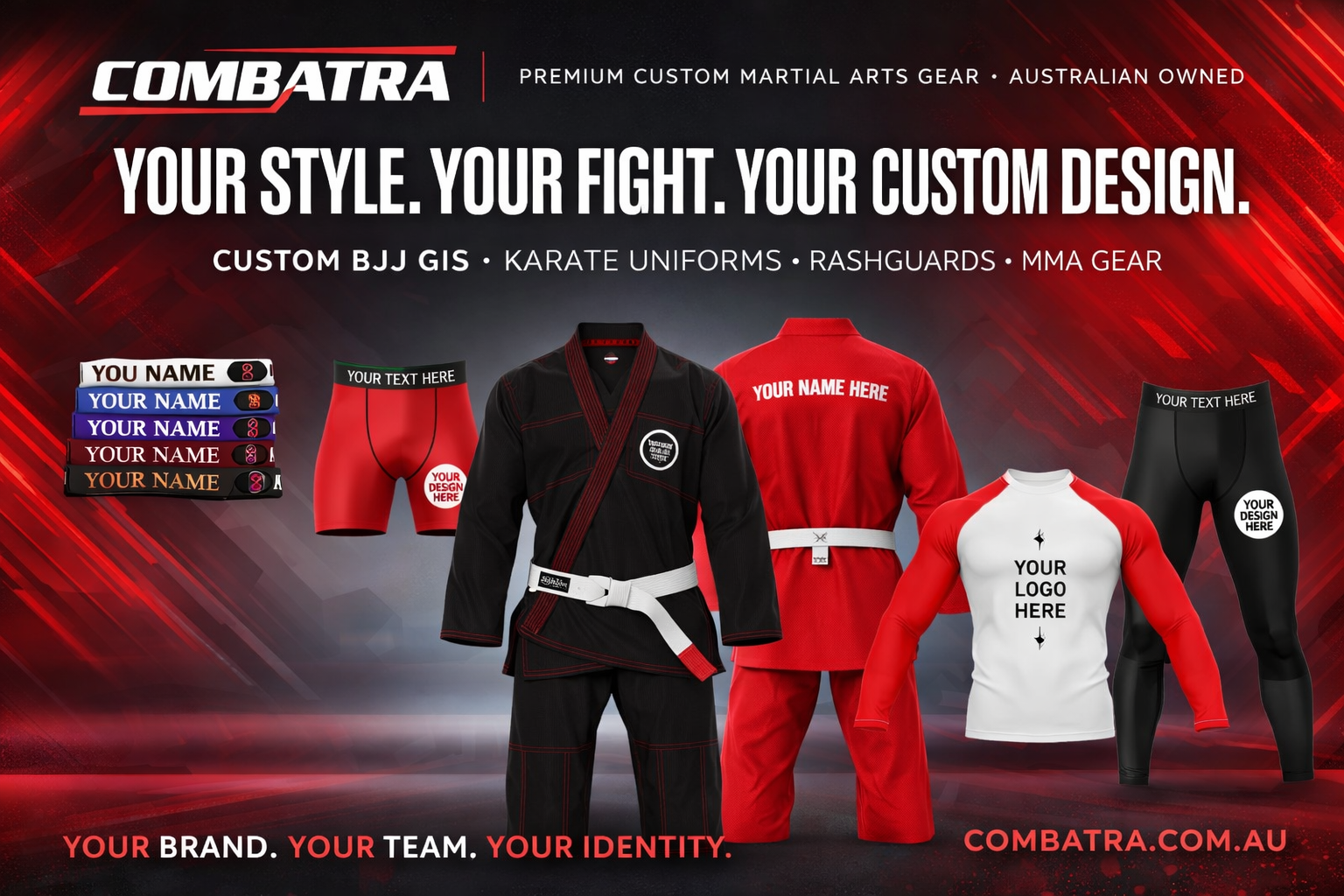
Combatra works directly with instructors and team managers to simplify the ordering process, from digital proofs through to delivery. The team understands the specific requirements of BJJ, Karate, and MMA uniforms, and can guide you through fabric weights, sizing, and customisation options suited to your discipline. Explore the full range of customisable martial arts gis and start building your team's kit today.
FAQ
How far in advance should I order custom team uniforms?
Start the procurement process at least 10 to 12 weeks before your season begins. Standard production takes 2 to 4 weeks after design approval, and shipping adds additional time on top of that.
What file format do I need for my team logo?
Your logo must be supplied as a vector file in .EPS or .AI format. Raster images such as JPEGs and PNGs cause quality loss when scaled and often result in additional art fees from the supplier.
How many extra uniforms should I order?
Order 2 to 4 units beyond your active roster count. These extras cover size exchanges, new members joining mid-season, and any items damaged during training or competition.
Can small clubs order custom martial arts uniforms?
Yes. Many specialised martial arts apparel suppliers, including Combatra, have no minimum order quantity, making custom gear accessible for small dojos and large academies alike.
What is the best way to collect sizing from my team?
Conduct a measurement session at practice and record chest, waist, hip, height, and weight for each athlete. Cross-reference these measurements against your supplier's sizing chart rather than relying on self-reported clothing sizes.
Key takeaways
Ordering custom martial arts uniforms successfully requires preparation, accurate data, and a clear brief submitted well before your season deadline.
| Point | Details |
|---|---|
| Start early | Begin procurement 10 to 12 weeks before your season to allow for production and shipping time. |
| Prepare vector artwork | Supply logos in .EPS or .AI format to avoid delays and additional art fees. |
| Measure athletes in person | Collect chest, waist, hip, height, and weight at practice for accurate sizing data. |
| Order buffer stock | Add 2 to 4 extra uniforms to cover size exchanges and mid-season roster changes. |
| Inspect on arrival | Check every item against your order confirmation within 48 hours and document any defects with photos. |