
TL;DR:
- Selecting well-fitting, high-quality custom rashguards enhances team performance and unity during training and competitions.
- Prioritizing fit, fabric durability, and proper sizing checks before ordering prevents costly mistakes and ensures athletes' comfort.
When a team shows up to competition or training in mismatched, ill-fitting rashguards, the message it sends is hard to ignore. Poor fit leads to garments riding up during scrambles, restricting movement at critical moments, and leaving athletes frustrated. Generic gear undermines team identity just as much as it undermines performance. Custom rashguards, chosen thoughtfully and ordered correctly, solve all of these problems at once. This guide walks you through every step, from clarifying your team's needs and locking in the right fit, to evaluating suppliers and making smart design decisions that will stand the test of training.
Table of Contents
- Understanding your team's requirements
- Essential features to prioritise in custom rashguards
- Making design choices: Customisation for team branding
- Sizing and fitting: Ensuring comfort and performance
- Ordering and evaluating suppliers
- The biggest mistake teams make with custom rashguards and how to avoid it
- Get started with custom rashguards for your team
- Frequently asked questions
Key Takeaways
| Point | Details |
|---|---|
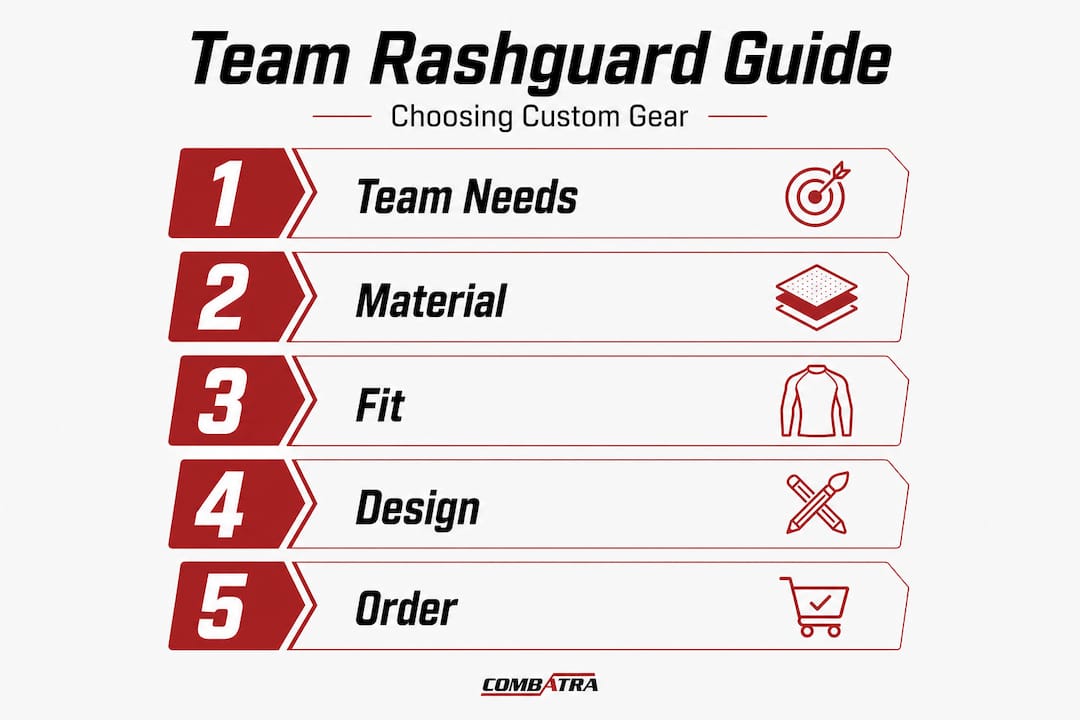
| Clarify team requirements | Start by defining your team's needs, goals, and customisation features before making rashguard decisions. |
| Prioritise performance fit | Choose a snug but not restrictive fit to maximise athlete comfort and prevent ride-up during training and competition. |
| Balance design and durability | Ensure custom graphics are paired with high-quality materials and printing for lasting impact. |
| Order samples first | Test sizing and print quality with samples to prevent costly mistakes for your whole team. |
| Vet suppliers carefully | Evaluate reputation, sample offerings, and support before committing to a large order. |
Understanding your team's requirements
With the need for quality rashguards established, it is essential to get clarity on what your team truly needs before you place a single order.
The first question to answer is: what is the primary purpose of these rashguards? A team competing in no-gi Brazilian Jiu-Jitsu (BJJ) tournaments needs a tighter compression fit to prevent garment interference during grappling. A team using rashguards for daily drilling sessions may prioritise breathability and wash durability above everything else. If you are ordering for a special event or promotional appearance, visual impact and branding will carry more weight. Knowing when to invest in custom rashguards saves time and budget from the start.
Once the purpose is clear, gather practical information from your team members:
- Full body measurements, not just rough size estimates. Rashguards fit differently from everyday clothing, and athletes who wear a medium t-shirt may need a different size in a compression garment.
- Athlete preferences for sleeve length, since some prefer long sleeves for mat burn protection and others prefer short sleeves for mobility.
- Any known sensitivities to fabrics or tight compression, particularly for newer or younger athletes.
- Rank or name details if personalisation is part of the plan.
- Colour preferences against your academy's existing branding palette.
For BJJ and no-gi competition, the second-skin fit standard is widely recognised: snug and compression-focused through the torso and sleeves so the garment stays in place during scrambles, while avoiding a fit so tight it restricts movement or circulation. This standard should frame every sizing decision you make.
Budget and order quantity also play a significant role. Smaller orders under ten units can be more expensive per item, while larger team orders often unlock better pricing. Many suppliers have minimum order quantities, so confirm these early. Using rashguards for team identity becomes much more powerful when the entire team is outfitted consistently, so factor in your full roster rather than just current regulars.
Pro Tip: Create a simple shared form or spreadsheet for your team to submit their measurements, preferences, and sizes. This reduces back-and-forth and gives you clean data to share directly with your supplier.
Essential features to prioritise in custom rashguards
With your key requirements set, you can now evaluate the critical features that determine the best rashguard for your team.
Fit is the single most important factor. Fit should be snug but not restrictive; too loose and the garment rides up during takedowns and guard passes, too tight and it limits your athletes' range of motion. This balance is what separates a well-designed competition rashguard from a poorly made one.
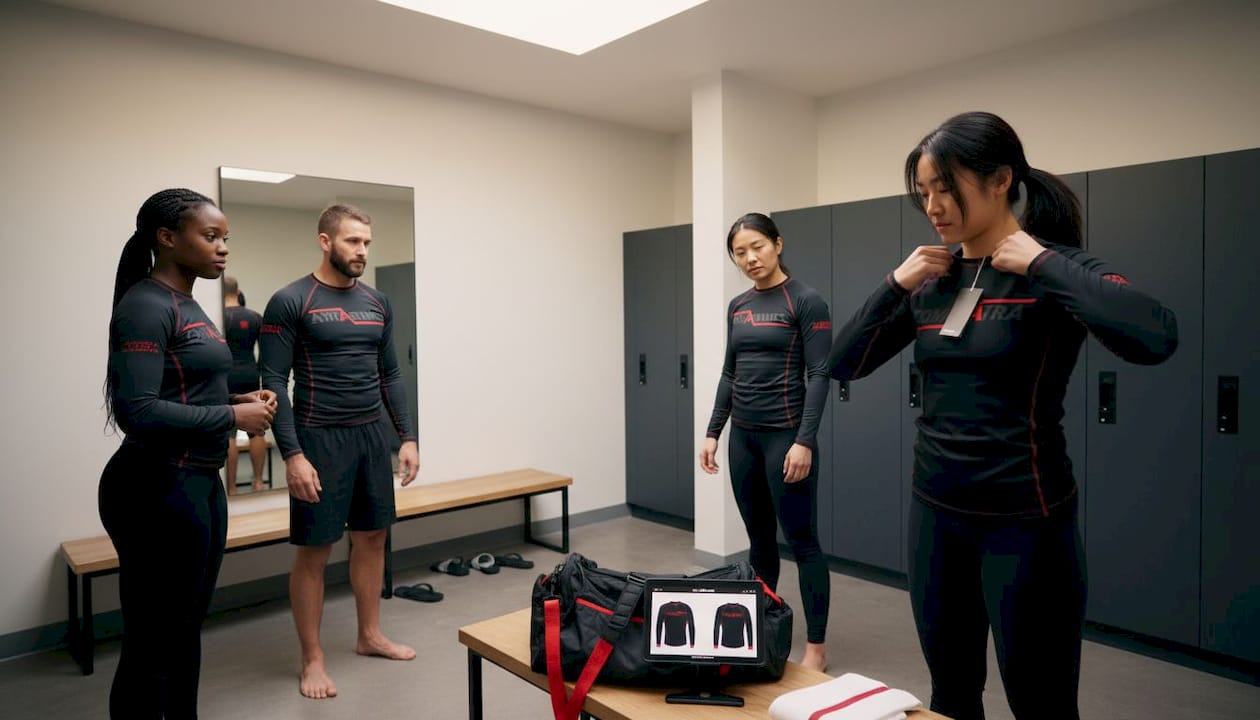
Beyond fit, the material composition matters greatly. High-quality rashguards for BJJ are typically made from a blend of polyester and spandex (also called elastane or Lycra). Polyester provides durability and moisture-wicking properties, pulling sweat away from the skin to keep athletes cool and comfortable. Spandex adds the four-way stretch needed for full grappling movement. A blend of around 80% polyester and 20% spandex is a common and effective standard.
Here is a quick comparison of the key features to assess when reviewing your options:
| Feature | Why it matters | What to look for |
|---|---|---|
| Compression fit | Prevents ride-up during grappling | Snug without restricting movement |
| Material blend | Affects breathability and stretch | Polyester/spandex blend |
| Stitching quality | Determines long-term durability | Flatlock or reinforced stitching |
| Print method | Impacts visual quality and longevity | Sublimation printing preferred |
| UPF rating | Relevant for outdoor training | UPF 50+ for sun protection |
| Weight of fabric | Affects comfort and durability | Mid-weight for all-round use |
Reinforced stitching deserves particular attention. During intense grappling, seams are under constant stress. Flatlock stitching (where the seam lies flat against the skin rather than sitting proud) reduces friction and chafing while improving durability. Poorly stitched rashguards often fail at the underarm or collar after only a few months of regular training.
Print quality is where many teams experience disappointment. Sublimation printing, where dye is infused directly into the fabric fibres under heat and pressure, produces the most vibrant and long-lasting results. Unlike heat transfers or screen printing, sublimation does not crack, peel, or fade after repeated washing. This is especially important for team orders where you want consistency across every garment for the life of the uniform.
For further guidance, the custom rashguard selection for BJJ resource provides detailed breakdowns of how to match technical specifications to your academy's training demands. You can also review rashguard sizing tips to complement your technical evaluation.
Pro Tip: Always request a fabric swatch or sample garment before committing to a full team order. Seeing and feeling the fabric in person tells you far more than a product description ever will.
Making design choices: Customisation for team branding
Beyond fit and fabric, the visual impact of your rashguards can set your team apart on and off the mat.
Start with your existing brand colours. Most academies already have a primary colour or colour palette used on their gi patches, website, and social media. Keeping your rashguards consistent with this palette builds immediate recognisability. If you are starting from scratch, choose colours with enough contrast to make logos and text legible under gym lighting and competition spotlights.
Here is a step-by-step approach to making strong design decisions:
- Lock in your base colour before adding any design elements. A dark base (black, navy, deep red) tends to show sweat less and photograph well for promotional use.
- Prepare your logo in vector format (.ai or .svg file). Vector files scale without pixelation, which matters enormously when your logo is being printed across garments of different sizes.
- Decide on logo placement early. Common positions include the chest, upper back, and left sleeve. Avoid placing logos in areas that will be under constant stress, such as the underarm or the small of the back.
- Add individual personalisation if your budget allows. Athlete names across the upper back or collar area add a professional touch and reduce gear mix-ups in busy change rooms.
- Consider rank differentiation. Some academies use subtle colour variations or trim changes to denote rank on team rashguards, which adds a functional element to the branding.
The method used for customisation also affects the final result. Sublimation printing allows for full-panel, all-over designs with no additional weight or texture to the fabric. This is the preferred option for creating team-branded rashguards that look and feel premium. For more detailed guidance on what customisation features are available and how to specify them accurately, the rashguard customisation features resource is well worth reviewing before you brief your supplier.
| Print method | Durability | Colour vibrancy | Texture on fabric | Best for |
|---|---|---|---|---|
| Sublimation | Excellent | High | None (seamless) | Full-colour team designs |
| Heat transfer | Moderate | Medium | Slight | Simple logos on plain garments |
| Screen print | Moderate | Medium | Raised feel | Large single-colour graphics |
Sizing and fitting: Ensuring comfort and performance
Choosing the right designs is only half the story. A great-looking rashguard must also fit every athlete comfortably to perform as intended.
Start by using the supplier's size chart as your primary reference, but do not rely on it blindly. Rashguard sizing is not universal across brands, and a "large" in one range may sit closer to a "medium" in another. Collect actual body measurements from your team (chest, waist, and hip circumference at minimum) and cross-reference these with the supplier's chart before assigning sizes.
A reliable fit check process for each athlete involves:
- Putting the rashguard on and performing a squat. If the hem rises above the waistband of shorts during the squat, the garment is too short in the torso.
- Raising both arms overhead. The rashguard should move with the body without pulling away from the waistband.
- Attempting a sprawl position. A sprawl mimics a common defensive BJJ movement and tests whether the garment restricts shoulder and hip mobility.
- Checking the collar and cuffs. These should lie flat without digging in or leaving red marks after five minutes of wear.
A practical fit check used widely in the BJJ community is that the fabric should stretch about an inch when gently pulled and snap back quickly when released. If it does not return to its original shape promptly, the elastane content is likely too low and the garment will lose its compression properties after repeated washing.
Ordering a sample garment before full production is one of the most valuable steps a team can take. It costs a small amount upfront but prevents the much larger cost of a full order that does not fit correctly.
The top custom rashguards for BJJ resource includes side-by-side comparisons of how different rashguard styles and fabrics perform across a range of body types, which can help you make more informed choices for a diverse team roster.
Pro Tip: If your team includes athletes with significantly different body types, consider ordering two or three sample sizes rather than just one. This gives you a broader fit picture before committing to the full production run.
Ordering and evaluating suppliers
Once you know what your team needs and how to ensure a good fit, the final challenge is choosing a supplier you can trust for quality and service.
Not all custom rashguard suppliers are created equal. Some offer low per-unit costs but cut corners on fabric quality or printing. Others have high minimum order quantities that do not suit smaller academies. Use the following checklist when vetting any supplier:
- Reputation and reviews. Look for suppliers with verified reviews from other martial arts academies, not just general sportswear customers. Team orders have specific requirements that not every supplier understands.
- Sample offering. A confident supplier will offer samples before a full order. If a supplier refuses or cannot provide a sample, this is a clear warning sign.
- Lead times. Custom production takes time. Most quality suppliers require between two and six weeks from artwork approval to dispatch. For competition-ready orders, always build in buffer time.
- Design support. Some suppliers provide in-house graphic designers to help prepare your artwork for print. This is particularly useful if your logo files are not print-ready.
- Return and exchange policy. Understand what happens if garments arrive with defects or if sizing is inconsistent across the order. A clear and fair policy protects your investment.
- Communication quality. Pay attention to how quickly and clearly a supplier responds to your initial enquiries. Poor communication early on often signals problems later in the process.
The choosing a rashguard supplier guide provides an in-depth breakdown of what to look for and what questions to ask before signing off on any order, which is especially useful if this is your first time ordering custom team apparel.
Pro Tip: Ask your supplier for references or images of previous team orders they have fulfilled. Seeing completed work from other academies gives you confidence that they can deliver on your specific brief.
The biggest mistake teams make with custom rashguards and how to avoid it
While following the steps above sets you up for success, a final lesson from years of team outfitting can help you avoid one of the costliest mistakes academies make.
The mistake is this: prioritising design over fit. It is an easy trap to fall into. The excitement of seeing your academy's logo rendered in full colour across a striking rashguard design can overshadow the practical details. We have seen teams invest significant budget into beautifully designed garments, only to find that athletes refuse to wear them because the fit is wrong. Garments that ride up, restrict shoulder movement, or dig into the neck do not get worn, regardless of how good they look.
One common scenario involves academies that skip the sample stage to save time before a competition. The full order arrives, the design looks fantastic in the packaging, but half the team finds the sizing inconsistent or the fabric stiffer than expected. By competition day, some athletes are wearing the new gear reluctantly and others have gone back to their old rashguards. The investment does not deliver its intended result.
The solution is to involve your athletes early and genuinely. Have a small group of volunteers, ideally including athletes with varied body types, try the sample garment and provide honest feedback before you finalise the order. Their input on fit, flexibility, and comfort is far more valuable than your own assessment alone. Understanding the purpose of rashguards in BJJ reinforces why fit must come first: rashguards exist to protect skin, aid thermoregulation, and stay in place during dynamic grappling. A rashguard that fails on any of these functions has failed its core purpose, regardless of how impressive the design is.
Great design and great fit are not competing priorities. With the right process, you achieve both.
Get started with custom rashguards for your team
With guidance in hand, the next logical step is to connect with a trusted provider specialising in custom solutions for martial arts teams.
At Combatra, we work directly with BJJ academies, MMA gyms, and martial arts clubs to create custom team rashguards that combine premium compression fit with striking, long-lasting sublimation designs. Our garments are built for real training conditions, with UPF 50+ protection, reinforced flatlock stitching, and four-way stretch fabric that performs through thousands of sessions.
Starting a custom order with us is straightforward. Share your team's size breakdown, your logo files, and your preferred colours, and our team will guide you from initial design concept through to final production. Whether you are outfitting five athletes or fifty, we can help. Explore the build your own rashguard option on our website to begin configuring your team's custom gear today.
Frequently asked questions
What is the most important aspect of rashguard fit for team competitions?
A snug, compression-focused fit that does not restrict movement is essential for team competitions. As widely recognised guidance confirms, fit should be snug but not restrictive, since too loose causes ride-up and too tight limits range of motion.
How do I check if a rashguard will fit my athletes properly?
Gently stretch the fabric about an inch and ensure it snaps back quickly; this confirms adequate elastane content for a lasting compression fit. This practical fit check is a reliable standard used across the BJJ community.
What are common mistakes when ordering custom rashguards for teams?
The biggest mistake is ordering based on design alone without verifying fit, fabric quality, and sizing consistency across the full team roster. Skipping the sample stage is a close second, as it removes your only opportunity to catch problems before full production.
Can team members have personalised names or details on their rashguards?
Yes, most quality suppliers offer name and rank customisation options, typically printed across the upper back or collar area, which enhances team identity and reduces gear mix-ups during training.