
TL;DR:
- Compression shorts are ideal for high-intensity and hot-weather training due to better airflow and mobility. Compression pants offer full leg coverage, reducing chafing and providing warmth in cooler conditions. Proper fit and pressure levels are essential for maximizing performance and recovery benefits.
Compression shorts and compression pants are specialised athletic garments designed to improve performance through muscle support, sweat management, and recovery enhancement. In combat sports like BJJ and MMA, as well as outdoor running and training, these garments also serve as a layer of abrasion protection and skin defence. For Australian athletes, the stakes are higher than most: UPF 50+ compression wear tested to AS 4399:2020 is not a luxury when training under Australian UV conditions. The compression shorts vs compression pants question does not have a single answer. The right choice depends on your training environment, workout intensity, and how your body responds to each garment type.
Compression shorts vs compression pants: what is each garment?
Compression shorts and compression pants are both form-fitting garments that apply graduated pressure to the muscles. They differ primarily in coverage length, and that difference drives most of the practical trade-offs.
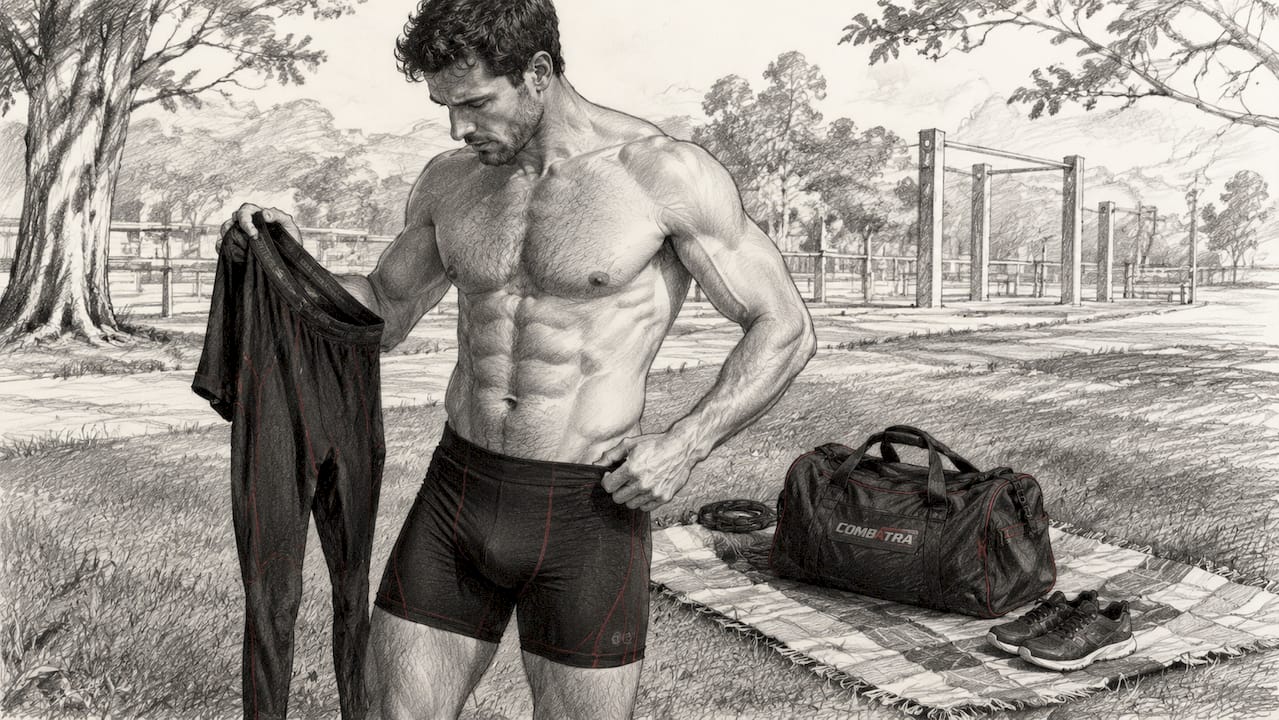
Compression shorts typically feature inseams in the 4–9 inch range. Inseam length affects function: 4–6 inch inseams suit road running and high-intensity sessions, while 7–9 inch options provide greater thigh coverage, abrasion protection, and thermal regulation for trail or hill work. Shorts are lighter, allow more airflow around the lower leg, and reduce bulk during rapid movements. They are the preferred choice for BJJ, MMA, and interval training where freedom of movement is non-negotiable.
Compression pants (also called compression tights or full-length compression leggings) extend to the ankle or mid-calf. They offer full leg coverage, which reduces chafing on longer runs, provides warmth in cooler conditions, and protects skin during ground-based grappling. The trade-off is reduced breathability and added thermal load in hot weather.
Key design features to understand for both garment types:
- Fabric construction: Interlock spacer fabrics with high elastane content deliver superior mechanical performance and consistent compression over time.
- Compression class: Sports compression typically targets 20–30 mmHg, which supports venous return and reduces muscle oscillation during impact.
- Graduated pressure: Pressure should be highest at the extremity and reduce toward the core. Poor graduation reduces physiological benefit.
- Seam placement: Flatlock seams reduce skin irritation during high-friction activities like grappling or trail running.
Understanding these design elements helps you evaluate garments beyond marketing claims and focus on what actually affects performance.
Which is better for performance and recovery?
Compression garments reliably reduce perceived muscle soreness 24–72 hours post-exercise. Their effect on objective performance measures like sprint power or jump height is smaller and less consistent. This distinction matters when you are deciding whether to invest in compression wear and which type to prioritise.
A meta-analysis by Hill et al. (2019) reported a standardised mean difference of −0.67 in perceived soreness reduction when using compression garments compared with a control group. That is a meaningful effect for recovery comfort, even if the biological mechanism is modest. The practical implication: compression wear is most valuable for managing training load and maintaining consistency, not for acute performance spikes.
Compression garments provide more consistent recovery comfort benefits than measurable performance improvements. If compression makes you feel better and train more consistently, that benefit is real and worth pursuing.
The table below compares the two garment types across key recovery and performance dimensions:
| Factor | Compression Shorts | Compression Pants |
|---|---|---|
| Soreness reduction | Effective for lower body, particularly quads and hamstrings | Effective across full leg, including calves and shins |
| Thermal load | Low, suits hot and humid conditions | Higher, suits cool or cold conditions |
| Chafe protection | Moderate, thigh coverage only | High, full leg coverage reduces friction |
| Post-exercise wear | Comfortable for extended wear in warm climates | Better for overnight recovery in cooler climates |
| Freedom of movement | High, preferred for grappling and speed work | Moderate, suited to steady-state endurance |
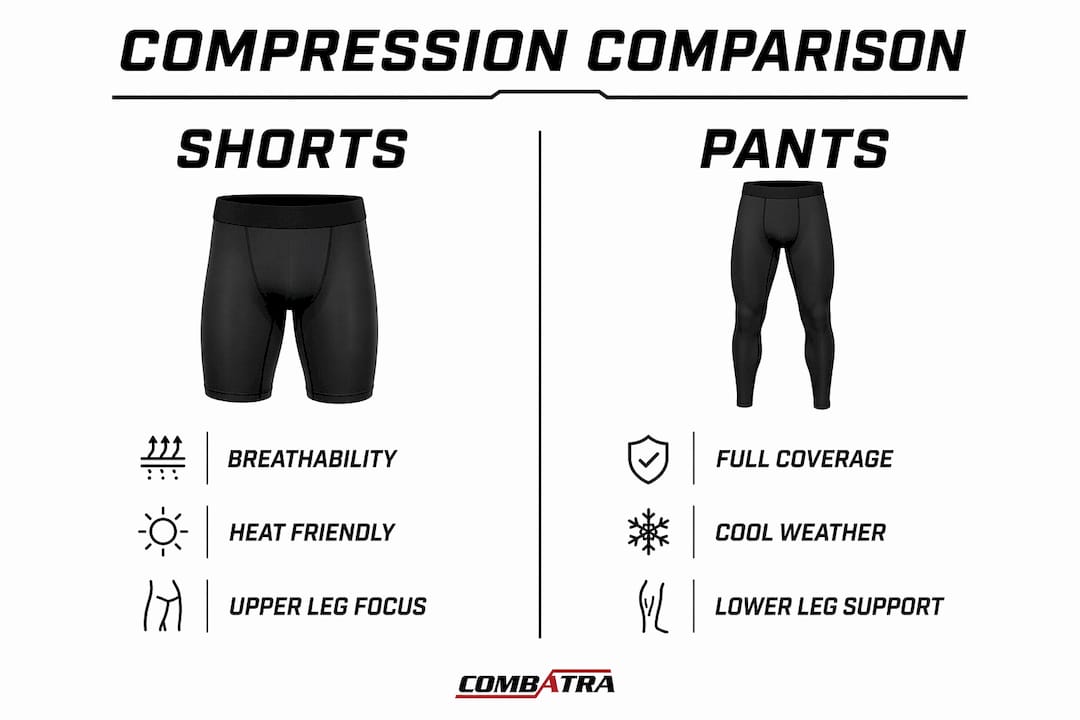
Longer wear periods and early post-exercise application improve recovery outcomes. A 2012 study found that 12-hour overnight compression wear increased countermovement jump heights following rugby training. Compression pants are better suited to overnight recovery use in cooler climates, while shorts are more practical for extended wear in warm Australian conditions.
How do temperature and workout type affect your choice?
The environment you train in is the single most practical factor in choosing between shorts and pants. Compression shorts perform best in heat and high-intensity workouts, while compression pants suit cooler conditions and longer-duration activities where chafe protection matters.
For Australian athletes, this distinction is especially relevant. Summer training sessions, outdoor BJJ, and beach-side running all create conditions where full-length tights become a liability. Excess heat retention raises core temperature, increases perceived effort, and reduces performance. Shorts allow airflow around the lower leg and reduce the thermal burden without sacrificing upper-leg compression.
Compression pants come into their own in the following scenarios:
- Trail running: Full coverage reduces abrasion from scrub, rocks, and uneven terrain.
- Cold-weather training: Thermal regulation across the full leg maintains muscle temperature and reduces injury risk.
- Long-distance running: Reduced chafing over 90-plus minutes makes tights more comfortable than shorts for many athletes.
- Recovery walks or cool-downs: Full-leg coverage supports venous return across the entire lower limb.
Pro Tip: If you train outdoors in Australia during summer, look for compression shorts with UPF 50+ fabric rated to AS 4399:2020. Sun protection and compression support are not mutually exclusive, and exposed skin during long sessions adds up to real UV damage over a season.
For compression wear in hot weather, the evidence consistently favours shorts. The breathability advantage is not marginal. It directly affects how hard you can train and how quickly you recover between sets or intervals.
What fit and design features should athletes prioritise?
Fit is the most underrated factor in compression wear. A garment that does not conform precisely to your limb dimensions will not deliver its intended pressure gradient, regardless of how well it is constructed.
Here is a practical checklist for evaluating compression garment fit and design:
- Check the pressure range. Graduated compression in the 20–30 mmHg range is the standard for sports applications. Garments below this threshold provide comfort but limited physiological benefit.
- Assess sleeve conformity. Lower pressure at the ankle reduces venous propulsion and physiological effects. If a garment bunches or gaps at any point, the pressure gradient is compromised.
- Test fabric recovery. Pull the fabric away from your thigh and release it. It should snap back immediately with no visible distortion. Slow recovery indicates elastane fatigue and reduced compression over time.
- Evaluate seam placement. Seams running along high-friction zones (inner thigh, behind the knee) will cause irritation during grappling or long runs. Flatlock construction is the minimum standard for combat sports use.
- Size for compression, not comfort. Compression garments should feel firm without restricting circulation. If you are between sizes, size down for better pressure delivery.
Pro Tip: Trial your compression garments across at least three different session types before committing to a preference. A garment that feels ideal during a short interval session may become uncomfortable during a 90-minute BJJ class. Real-world testing across conditions gives you data that no size chart can.
For custom compression wear, precise sizing and pressure gradient design are the primary advantages over off-the-shelf options. Athletes with non-standard proportions often find that custom garments deliver noticeably better compression consistency.
How to integrate compression wear into your training routine
Compression wear delivers the most benefit when you treat it like any other recovery tool: apply it with intention, track your response, and adjust based on outcomes.
Practical guidelines for integrating compression shorts or pants into your routine:
- Wear compression immediately post-exercise. Early application captures the window when muscle inflammation and fluid accumulation are highest. Do not wait until the next morning.
- Use shorts for speed and intensity sessions. Interval training, sparring rounds, and circuit work all benefit from the reduced thermal load and freedom of movement that shorts provide.
- Switch to pants for endurance and cold-weather sessions. Long runs, recovery jogs, and outdoor training in cooler months are where full-length coverage earns its place.
- Consider overnight wear for heavy training blocks. The 12-hour overnight compression protocol showed measurable improvements in jump performance post-rugby training. This is a practical option during competition preparation or high-volume training weeks.
- Combine with other recovery methods. Compression is one tool. Cold water immersion, sleep quality, and nutrition all moderate recovery outcomes. Compression works best as part of a complete recovery approach, not as a standalone solution.
The subjective comfort benefit of compression wear is real, even when the biological mechanism is modest. If wearing compression shorts after a hard BJJ session makes you feel less sore and more willing to train the next day, that outcome has genuine value for your long-term training consistency.
Key takeaways
Compression shorts suit heat and intensity; compression pants suit coverage and cooler conditions. Fit, pressure, and wear timing determine which garment delivers the most benefit for your training context.
| Point | Details |
|---|---|
| Shorts suit heat and intensity | Choose compression shorts for high-intensity, hot-weather, and grappling sessions where airflow matters. |
| Pants suit coverage and cold | Compression pants reduce chafing and retain warmth for trail running, long runs, and cooler climates. |
| Fit determines effectiveness | Graduated pressure in the 20–30 mmHg range only works if the garment conforms precisely to your limb. |
| Recovery benefit is consistent | Compression reliably reduces perceived soreness 24–72 hours post-exercise, supporting training consistency. |
| Trial across session types | Test both garments across different workouts before deciding. Context determines which option works for you. |
What i have learned from years of watching athletes choose the wrong garment
Most athletes pick compression wear based on aesthetics or brand loyalty, then wonder why the recovery benefit feels inconsistent. The research is clear: garment fit, pressure magnitude, and wear timing are the variables that actually determine outcomes. A well-fitted pair of compression shorts will outperform a poorly fitted pair of compression pants every time, regardless of which garment theoretically covers more muscle.
My honest observation is that Australian athletes tend to underestimate heat as a factor. Full-length tights in a Queensland summer BJJ class are not just uncomfortable. They actively work against you by raising your core temperature and reducing your capacity to train hard. Shorts are not a compromise in that context. They are the correct choice.
That said, I have seen athletes dismiss compression pants entirely because they trained in them once during summer and hated the experience. That is a context error, not a garment failure. The same athlete who struggles in tights during a hot interval session may find them genuinely valuable for a cold-morning trail run or an overnight recovery protocol.
My recommendation is to own both. Use shorts as your default for combat sports and warm-weather training. Keep pants for endurance work, cooler conditions, and post-training recovery. Treat the choice as a training decision, not a brand preference. And always prioritise fit over everything else. A garment that does not conform to your body is just expensive lycra.
— McGinnis
Gear built for australian athletes who train hard
Combatra designs compression wear for the conditions Australian athletes actually face: high UV exposure, intense training environments, and the physical demands of BJJ, MMA, and outdoor sport. Every garment is built with durability, precision fit, and UPF 50+ sun protection in mind.
Whether you need compression shorts for BJJ or full-length compression pants for training, Combatra offers custom options you can personalise with your name, academy logo, or team colours. If you want compression wear that performs under real conditions, not just in product photos, explore the full Combatra range. You can also browse custom rashguards with UPF 50+ protection for complete training coverage.
FAQ
What is the main difference between compression shorts and pants?
Compression shorts cover the upper leg and offer greater breathability, making them better for heat and high-intensity training. Compression pants provide full leg coverage, reducing chafing and retaining warmth for cooler conditions and longer sessions.
Are compression shorts effective for recovery?
Yes. Research shows compression garments produce a standardised mean difference of −0.67 in perceived soreness reduction compared with no compression. The benefit is most consistent for soreness management 24–72 hours post-exercise.
How long should you wear compression garments after training?
Applying compression immediately post-exercise is most effective. A 12-hour overnight wear protocol has shown measurable improvements in jump performance following rugby training, making extended wear a practical option during heavy training blocks.
What compression pressure is best for sport?
Graduated compression in the 20–30 mmHg range is the standard for sports applications. Proper sleeve conformity is critical: gaps or bunching in the garment reduce the pressure gradient and diminish physiological benefit.
Should women choose compression shorts or pants for training?
The choice follows the same principles as for any athlete: shorts for heat and high-intensity sessions, pants for cooler conditions and longer-duration work. Women training in BJJ or MMA often prefer women's compression shorts for grappling due to the freedom of movement they provide.