
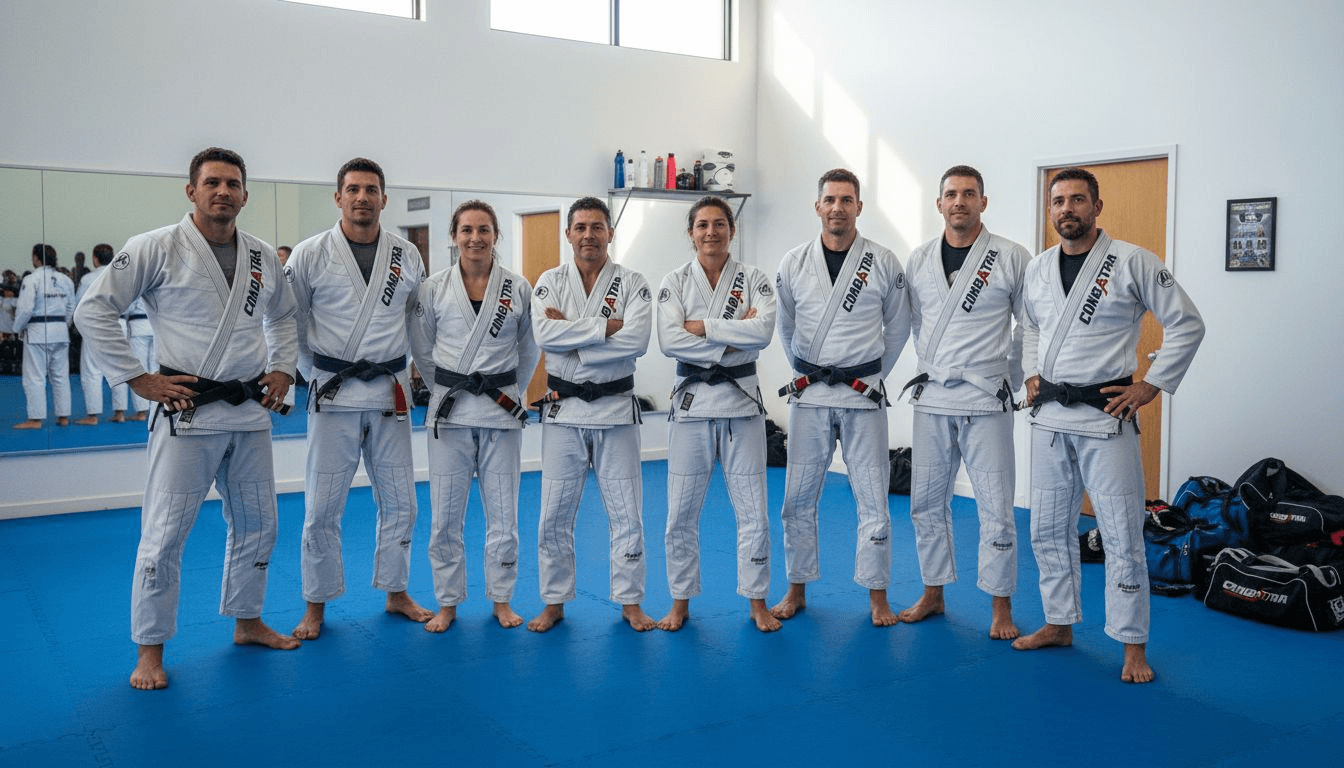
Many academy owners dismiss custom BJJ gis as vanity purchases, missing their strategic value. Custom gis are powerful investments that build team unity, strengthen branding, and generate revenue. Research shows academies adopting custom gis see up to 80% improved team cohesion and 10 to 20% revenue increases. Beyond aesthetics, custom gis deliver tailored fits, superior durability, and professional identity that sets your academy apart. This guide explores how custom gis transform academies from standard gyms into recognizable brands while enhancing athlete experience and financial outcomes.
Table of Contents
- Introduction: What Makes A Custom BJJ Gi?
- How Custom Gis Foster Team Unity And Branding
- Customization Options And Their Impact On Cost And Performance
- Financial Implications And Revenue Opportunities
- Durability And Fit Advantages Of Custom-Made Gis
- Common Misconceptions About Custom BJJ Gis
- Ordering Process And Choosing The Right Manufacturer
- Conclusion: Making The Decision For Your Academy
- Enhance Your Academy With Custom Gear From Combatra
Key takeaways
| Point | Details |
|---|---|
| Team unity and branding | Custom gis create unified team identity, improving cohesion by up to 80% and strengthening brand visibility. |
| Revenue opportunities | Academies integrating custom gi programs report 10 to 20% revenue increases through student sales. |
| Superior fit and durability | Tailored sizing enhances athlete comfort while premium fabrics extend gi lifespan, reducing replacement costs. |
| Customization flexibility | Options include fabric types, embroidery, patches, and color schemes that align with academy branding and IBJJF compliance. |
| Common misconceptions | Custom gis are strategic branding investments, not vanity purchases, with measurable returns on team culture and revenue. |
Introduction: what makes a custom BJJ gi?
A custom BJJ gi is a martial arts uniform personalized specifically for your academy's brand, sizing requirements, and design preferences. Unlike off-the-shelf gis that come in standard cuts and generic colors, custom gis feature tailored dimensions, embroidered academy logos, unique color combinations, and fabric choices that align with your training philosophy and competitive needs.
Key features that distinguish custom gis include precision sizing based on athlete measurements, fabric selection from pearl weave to gold weave options, embroidered or patched branding elements, contrast stitching for visual impact, and color schemes that reflect academy identity. These elements combine to create uniforms that fit better, last longer, and represent your academy professionally both on and off the mat.
Academies invest in custom gis for several strategic reasons:
- Building unified team identity that increases student pride and belonging
- Creating strong visual branding that attracts new students and sponsors
- Improving athlete comfort and performance through tailored fits
- Generating additional revenue streams by selling branded gear to students
- Establishing professional appearance at competitions and events
The difference between custom and standard gis extends beyond surface aesthetics. Standard gis force athletes into generic sizing that rarely fits perfectly, leading to discomfort during training and frequent adjustments. Custom gis address individual body types, accommodate growing youth students, and consider specific training styles whether your academy focuses on competition or self-defense.
For academies evaluating this investment, custom gis represent a shift from viewing uniforms as basic training requirements to recognizing them as strategic assets that influence culture, performance, and business outcomes. The initial decision to pursue custom gis typically stems from a desire to elevate academy professionalism and create tangible differentiation in competitive local markets.
How custom gis foster team unity and branding
Custom gis create immediate visual cohesion that transforms individual students into a recognizable team. When your entire academy walks onto competition mats wearing matching colors, coordinated patches, and professional embroidery, it signals organization, commitment, and pride. This unified appearance builds psychological bonds among students who feel part of something larger than themselves.
Research indicates up to 80% of academies report improved team cohesion after adopting custom gis. Students wearing academy colors develop stronger loyalty and connection to training partners, reducing dropout rates and increasing class attendance. The shared identity created by custom uniforms extends beyond the gym, with students proudly wearing their gis to competitions, seminars, and community events.
Branding benefits of custom gis include:
- Enhanced visibility at tournaments where dozens of academies compete simultaneously
- Professional appearance that attracts prospective students during trial classes
- Social media content opportunities showcasing unified team photos and videos
- Sponsor appeal when seeking partnerships with local businesses
- Alumni connection as former students recognize and remember academy colors
The psychological impact of custom gis mirrors professional sports team uniforms. Students training in personalized academy gear experience elevated status and belonging compared to those in generic white gis. This emotional connection translates to measurable retention improvements, with academies noting students are 15 to 25% less likely to quit within their first year when custom uniforms are standard.
"Our student retention improved dramatically after introducing custom gis. Students feel proud to represent our academy colors, and parents frequently comment on the professional atmosphere it creates. The investment paid for itself within six months through reduced churn and increased referrals."
Brand visibility extends far beyond your academy walls. Students wearing custom gis at open mats, competitions, and cross-training sessions become walking advertisements. Each appearance reinforces your academy's visual identity, creating recognition that supports enrollment growth and community reputation. Similar strategies using custom rashguards boosting academy identity demonstrate how branded gear amplifies marketing efforts organically.
Customization options and their impact on cost and performance
Custom gi pricing and performance characteristics depend heavily on fabric choices, design complexity, and order volume. Understanding these variables helps academy owners make informed decisions that balance budget constraints with quality requirements.
Fabric types represent the primary cost and performance differentiator:
- Single weave: Lightweight and affordable, ideal for hot climates but less durable for intense training
- Pearl weave: Balanced weight and durability, most popular choice for academies seeking versatility
- Gold weave: Premium durability and professional appearance, higher cost but extended lifespan
- Double weave: Heaviest and most durable, preferred for competition but can restrict movement
Customization elements that influence pricing include embroidery placement and thread count, patch application and materials, contrast stitching colors, custom linings and interior labels, and specialty treatments like pre-shrinking or reinforced stress points. Each additional feature adds 5 to 15% to base costs, but creates unique branding opportunities unavailable with standard gis.
| Customization Level | Base Cost Per Unit | Typical Features | Best For |
|---|---|---|---|
| Basic | $45 to $65 | Single logo, standard colors, pearl weave | Small academies, youth programs |
| Standard | $65 to $95 | Multiple logos, contrast stitching, custom patches | Mid-size academies, competition teams |
| Premium | $95 to $140 | Gold weave, full embroidery, custom linings, reinforcements | Elite programs, professional branding |
IBJJF competition compliance critically affects design decisions. The International Brazilian Jiu-Jitsu Federation mandates specific color restrictions (white, blue, or black only), patch size and placement limits, and contrast stitching rules. Choosing BJJ gi performance options that meet these standards ensures your students can compete without uniform violations.
Order volume dramatically impacts per-unit pricing. Manufacturers typically offer tiered pricing where 10 to 24 units cost 100% of base price, 25 to 49 units receive 10 to 15% discounts, 50 to 99 units receive 15 to 25% discounts, and 100 plus units receive 25 to 35% discounts. Larger academies achieve better economies of scale, while smaller gyms can partner with neighboring schools to reach volume thresholds.
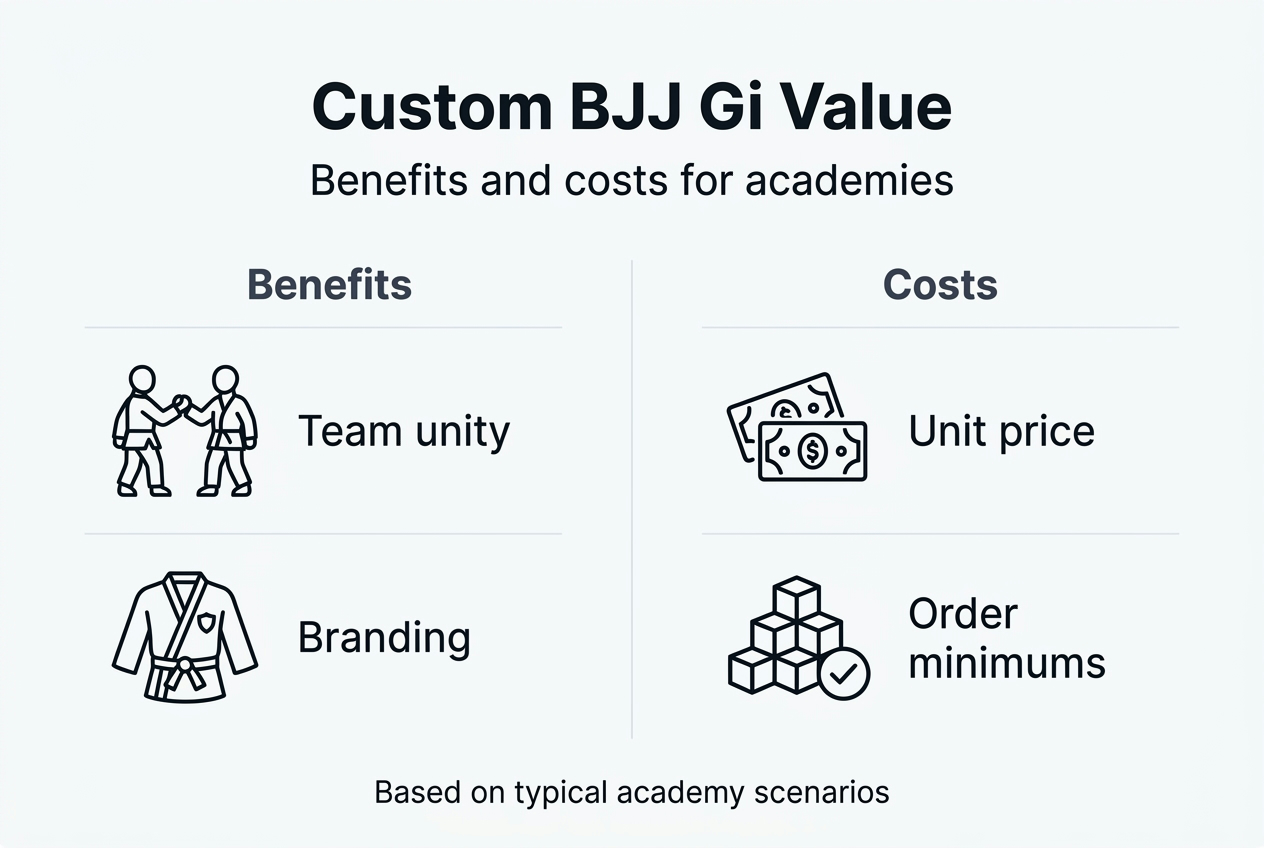
Pro Tip: Request fabric samples and test gis from potential manufacturers before committing to bulk orders. Testing reveals actual weight, comfort, and durability that specifications alone cannot convey. Many manufacturers offer custom blue BJJ gi options in sample quantities specifically for this purpose.
Financial implications and revenue opportunities
Custom gi programs generate multiple revenue streams while supporting academy branding objectives. Understanding the financial model helps owners evaluate return on investment and structure profitable programs.
Typical pricing structures for custom gis vary by academy size and ordering approach:
| Academy Size | Order Quantity | Cost Per Gi | Retail Price | Profit Margin |
|---|---|---|---|---|
| Small (25 to 50 students) | 15 to 30 units | $70 to $85 | $140 to $170 | 40 to 50% |
| Medium (50 to 100 students) | 30 to 60 units | $60 to $75 | $130 to $160 | 45 to 55% |
| Large (100 plus students) | 60 plus units | $50 to $65 | $120 to $150 | 50 to 60% |
Revenue opportunities from custom gi programs include:
- Direct sales to existing students as required or optional uniforms
- New student enrollment packages bundling gi with membership fees
- Competition team gear sold to parents and supporters
- Retail inventory for drop-in visitors and trial class conversions
- Online sales to alumni and remote students maintaining academy connections
Data shows academies integrating custom gis experience 10 to 20% revenue increases beyond standard membership income. This additional revenue supports instructor salaries, facility improvements, and competition travel funding. The margin structure allows academies to price competitively while maintaining healthy profits that offset initial investment costs.
Cost-benefit analysis reveals break-even timelines vary by implementation approach. Academies requiring custom gis for all students typically recover initial investments within 3 to 6 months through direct sales and reduced marketing costs. Optional programs take 8 to 12 months but create less resistance from price-sensitive families.
Small academy scenario: A 40-student academy orders 25 custom gis at $75 each ($1,875 total investment). Selling 20 gis at $150 generates $3,000 revenue and $1,125 profit after covering costs. Remaining 5 gis serve as retail inventory, with 80% selling within 6 months for additional $600 profit. Total first-year profit reaches $1,725, representing 92% return on initial investment.
Medium academy scenario: A 75-student academy orders 50 gis at $65 each ($3,250 investment). Selling 45 gis at $140 produces $6,300 revenue and $3,050 profit. Combined with improved retention (estimated 3 additional students retained monthly at $150 membership), annual revenue impact exceeds $8,400.
Large academy scenario: A 150-student academy orders 100 gis at $55 each ($5,500 investment). Selling 90 gis at $130 generates $11,700 revenue and $6,200 profit. Enhanced branding attracts 5 additional monthly enrollments (conservatively), adding $9,000 annual membership revenue. Total financial impact reaches $15,200 annually.
Durability and fit advantages of custom-made gis
Custom gis deliver performance benefits that directly impact athlete training quality and academy operational costs. Tailored fits eliminate common frustrations with standard sizing while premium materials reduce replacement frequency.
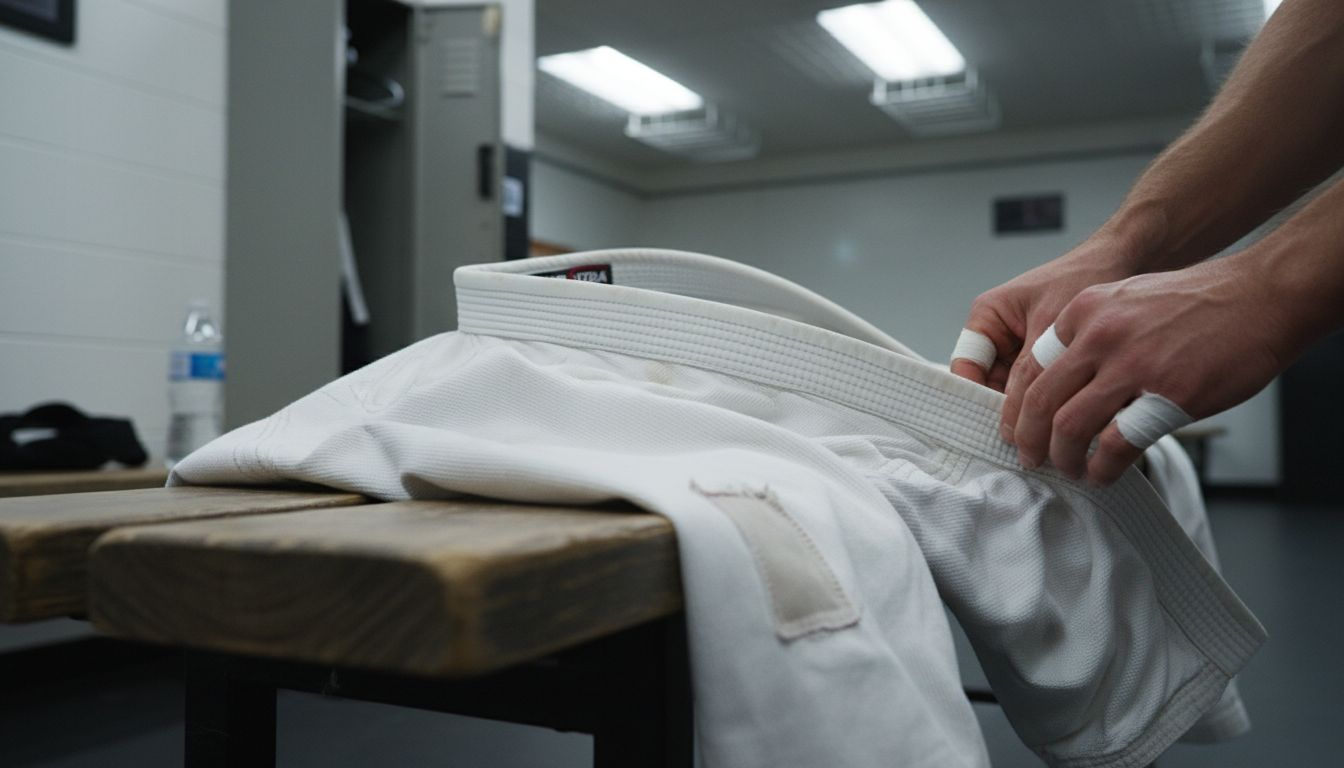
Tailored sizing addresses individual body variations that generic size charts cannot accommodate. Athletes with longer torsos, broader shoulders, or unique proportions struggle with off-the-shelf gis that gap, bind, or require constant adjustment. Research shows custom gis offer superior fit compared to off-the-shelf gis, improving athlete comfort and performance, especially for orders 100 plus units where precise measurements justify customization investments.
Fit advantages include:
- Sleeve and pant lengths matching exact measurements, preventing excess fabric interference
- Torso dimensions accommodating athletic builds without restrictive tightness
- Shoulder width adjustments preventing binding during arm movements
- Youth sizing that accommodates growth without immediate replacement needs
- Women-specific cuts addressing hip and torso proportion differences
Premium fabric choices in custom gis significantly extend usable lifespan compared to budget alternatives. Gold weave and reinforced pearl weave fabrics resist tearing at stress points, maintain shape after repeated washing, and preserve color vibrancy through years of training. While initial costs run 20 to 40% higher, durability improvements reduce replacement frequency by 50 to 70%, creating long-term cost savings.
Proper care extends custom gi longevity regardless of fabric quality. Academy owners should educate students on cold water washing, air drying instead of machine drying, immediate post-training washing to prevent bacteria buildup, proper storage to avoid mildew, and regular inspection of seams and patches for early repair opportunities.
Custom gis reduce uniform-related training disruptions. Students confident in their gi fit and durability focus on technique rather than adjusting pants or retying belts. Competition performance improves when athletes trust their uniforms won't fail during critical moments. Understanding what is a custom gi performance benefits helps academies communicate these advantages to students justifying premium pricing.
Pro Tip: Implement a gi inspection program during promotions where instructors check uniform condition and provide care guidance. This maintains professional appearance standards while extending gi lifespan through proactive maintenance education.
Common misconceptions about custom BJJ gis
Several myths prevent academy owners from adopting custom gi programs despite substantial benefits. Addressing these misconceptions clarifies the strategic value custom gis provide.
Myth: Custom gis are vanity purchases with no practical value. Reality: Custom gis deliver measurable returns through improved retention, enhanced branding, and revenue generation. Studies indicate up to 40% of academy owners initially underestimate the branding benefits of custom gis, seeing them as mere vanity purchases. Once implemented, most recognize the strategic advantages within the first training cycle.
Myth: Mandatory gi policies exist solely to boost gear sales and exploit students. Reality: Uniform requirements create professional standards, build team identity, and ensure training safety through consistent quality. Academies transparent about pricing and policy rationale face minimal resistance. Students and parents appreciate clear expectations when explained as program elements rather than profit schemes.
Key misconceptions to address:
- Custom gis are prohibitively expensive for most students (reality: bulk pricing and payment plans make them accessible)
- Standard gis perform identically to custom options (reality: fit and durability differences significantly impact training experience)
- IBJJF compliance is too complicated for custom designs (reality: experienced manufacturers ensure regulation adherence)
- Only large academies benefit from custom gi programs (reality: small gyms gain proportionally greater branding impact)
- Custom gis discourage new students from joining (reality: professional appearance attracts serious practitioners)
Branding benefits consistently surprise academy owners who implement custom gi programs. The visual impact of unified teams at competitions generates word-of-mouth marketing worth thousands in advertising value. Parents photograph their children in academy colors, creating organic social media content that reaches prospective students. Alumni maintain emotional connections to academy brands long after leaving, sometimes returning years later because the visual identity remained memorable.
Transparency about custom gi programs builds trust with students and families. Clearly communicate pricing structures, explain how revenues support academy operations, offer payment plans for families facing financial constraints, and provide alternative uniform options when appropriate. Academies positioning custom gis as program investments rather than mandatory purchases face significantly less resistance while achieving similar adoption rates.
Ordering process and choosing the right manufacturer
Successfully implementing a custom gi program requires careful manufacturer selection and systematic ordering processes. Following proven steps ensures quality outcomes and smooth rollouts.
Key criteria for manufacturer selection:
- BJJ-specific experience with proven academy partnerships and competition-grade products
- Quality certifications and fabric sourcing transparency with sample availability
- Pricing clarity including hidden fees for artwork, revisions, and shipping
- Production timelines with realistic estimates and contingency buffers
- IBJJF compliance expertise ensuring designs meet regulation requirements
- Communication responsiveness during inquiry and ordering phases
- Sample approval processes allowing physical inspection before bulk production
Typical custom gi ordering timelines span 6 to 12 weeks from initial contact to delivery. The process includes initial consultation and goal assessment (week 1), design mockup creation and revision (weeks 2 to 3), sample production and approval (weeks 4 to 6), bulk production (weeks 7 to 10), and shipping and delivery (weeks 11 to 12). Rush orders may condense timelines by 20 to 30% with premium fees.
Step-by-step ordering process:
- Assess academy goals, budget constraints, and quantity requirements based on student population
- Research and contact 3 to 5 manufacturers requesting quotes and portfolio samples
- Evaluate proposals comparing pricing, timelines, customization options, and references
- Select manufacturer and finalize design through collaborative mockup process
- Review and approve physical samples, testing fit, fabric quality, and embroidery precision
- Place bulk order with 50% deposit (standard industry practice)
- Monitor production milestones through manufacturer updates and progress photos
- Coordinate delivery logistics and inspect shipment upon arrival
- Distribute gis to students with care instructions and sizing guidance
- Gather feedback for future orders and maintain manufacturer relationship
IBJJF compliance review before final production prevents costly mistakes. Verify gi colors match approved white, blue, or black standards, confirm patch sizes and placements fall within regulation zones, and ensure contrast stitching follows federation rules. Experienced manufacturers guide this process, but academy owners should independently review IBJJF uniform requirements to catch potential issues early.
Scaling tips for growing academies include starting with small pilot orders (15 to 25 units) to test manufacturer quality and student reception, implementing pre-order systems where students commit before production begins, establishing annual ordering cycles that leverage volume discounts, and maintaining inventory buffers for new student enrollments and unexpected demand.
Pro Tip: Build relationships with manufacturers by providing testimonials and social media features in exchange for priority service and preferential pricing on future orders. Long-term partnerships yield better outcomes than constantly switching suppliers. Explore resources on personalizing BJJ gi design and use tools to design your own BJJ gi for visual planning before manufacturer consultations.
Conclusion: making the decision for your academy
Custom BJJ gis represent strategic investments that extend far beyond aesthetic preferences. The evidence supporting their adoption is compelling: up to 80% improved team cohesion, 10 to 20% revenue increases, superior athlete comfort through tailored fits, and enhanced academy branding that attracts students and sponsors.
Evaluating whether custom gis suit your academy requires honest assessment of current goals, student population size, budget flexibility, and competitive positioning. Small academies benefit from differentiation in crowded markets, while larger programs leverage economies of scale for maximum profit margins. Both scenarios present viable paths to positive returns when implemented thoughtfully.
Simple next steps to launch your custom gi program:
- Survey students and parents gauging interest and preferred pricing structures
- Research 3 to 5 manufacturers requesting quotes and portfolio samples
- Create initial design concepts incorporating academy logos and colors
- Start with pilot orders testing quality and student reception
- Establish clear policies and communication around uniform expectations
- Monitor results tracking retention, revenue, and student satisfaction metrics
Pro Tip: Prioritize IBJJF compliance and fabric quality over design complexity in your first custom gi order. Establishing reliable manufacturer partnerships and proving program viability matters more than perfect aesthetics initially. Refinements come naturally in subsequent orders once the foundation is solid.
Enhance your academy with custom gear from Combatra
Now that you understand how custom gis transform academy culture and financial performance, it's time to explore solutions that bring these benefits to your students. Combatra specializes in premium custom BJJ gis featuring pearl and gold weave fabrics, precision embroidery, and design flexibility that reflects your unique academy identity.
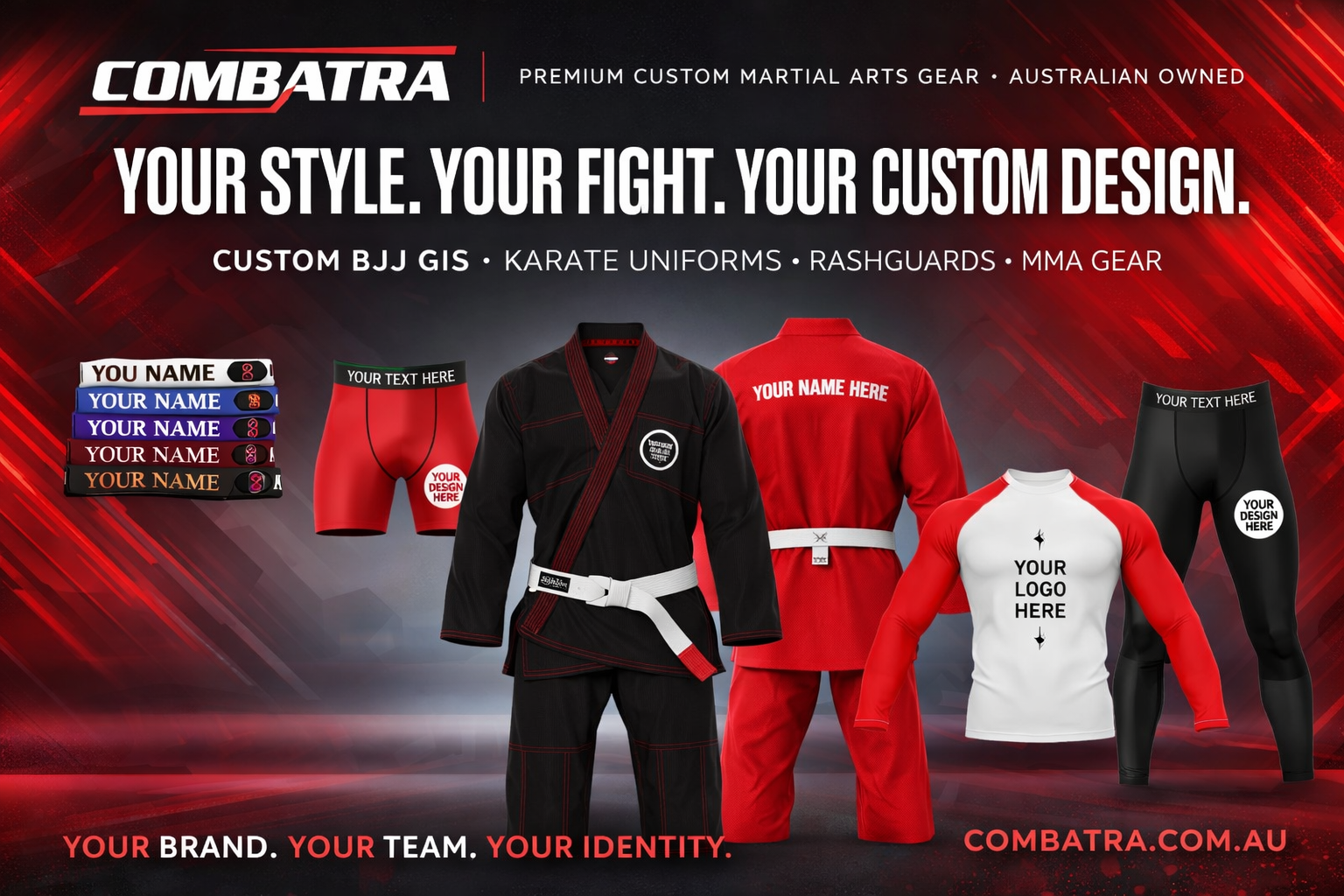
Our streamlined customization process ensures IBJJF compliance while delivering professional results that elevate your brand. Whether you're ordering 15 gis for a youth program or 100 for a full academy rollout, Combatra provides transparent pricing, quality assurance, and dedicated support throughout production. Explore our design your own BJJ gi tool to visualize your academy colors and logos, review our item personalization options for additional branding elements, or contact our team to discuss bulk order pricing tailored to your budget. Visit Combatra today and take the first step toward building a unified, professional academy identity that students wear with pride.
FAQ
Is it difficult to ensure IBJJF compliance with custom gis?
Most reputable manufacturers specializing in BJJ gear have extensive experience ensuring designs meet IBJJF standards. Early design consultation helps identify potential compliance issues before production begins. Verify that your manufacturer reviews color restrictions, patch placement zones, and contrast stitching rules as standard practice.
Can custom gis really improve student retention at my academy?
Research and academy reports consistently show team unity from custom gis boosts retention rates. Students wearing professional academy colors develop stronger emotional connections to training partners and instructors. The pride associated with representing a recognizable brand reduces dropout likelihood, particularly during challenging early training months when many students quit.
What is the typical lead time for a custom gi order?
Lead times generally range from 6 to 12 weeks depending on manufacturer capacity and order complexity. Sample approval and design finalization affect overall timeline significantly. Academies planning seasonal launches or competition deadlines should initiate orders at least 14 weeks in advance to accommodate potential delays or required revisions.
Are custom gis more expensive than standard gis?
Custom gis cost more upfront, typically 30 to 60% above comparable off-the-shelf options. However, superior durability, tailored fit, and branding benefits often justify the price difference. Long-term value exceeds initial cost through extended lifespan, reduced replacement frequency, and revenue generation opportunities that standard gis cannot provide.