

TL;DR:
- Designing a custom BJJ gi involves selecting fabric, ensuring IBJJF compliance, and choosing appropriate patches to build team identity. Proper construction, reinforcement, and accurate patch placement are crucial for durability and competition approval. Involving your team in design decisions and verifying specifications from the start help prevent costly mistakes and ensure a professional, compliant uniform.
Designing a custom BJJ gi for your academy is the process of specifying fabric construction, patch placement, sizing, and branding to create a uniform that represents your team and meets competition standards. A well-designed gi does more than look sharp on the mat. It builds team identity, signals professionalism to prospective members, and gives your athletes confidence walking into any tournament. The International Brazilian Jiu-Jitsu Federation (IBJJF) governs gi specifications tightly, including sleeve and pant tolerances updated in 2024 to within 2 cm of the wrist and ankle bone respectively. Getting the design right from the start means understanding materials, compliance rules, and patch technology before you place a single order.
How to design a custom BJJ gi for your academy
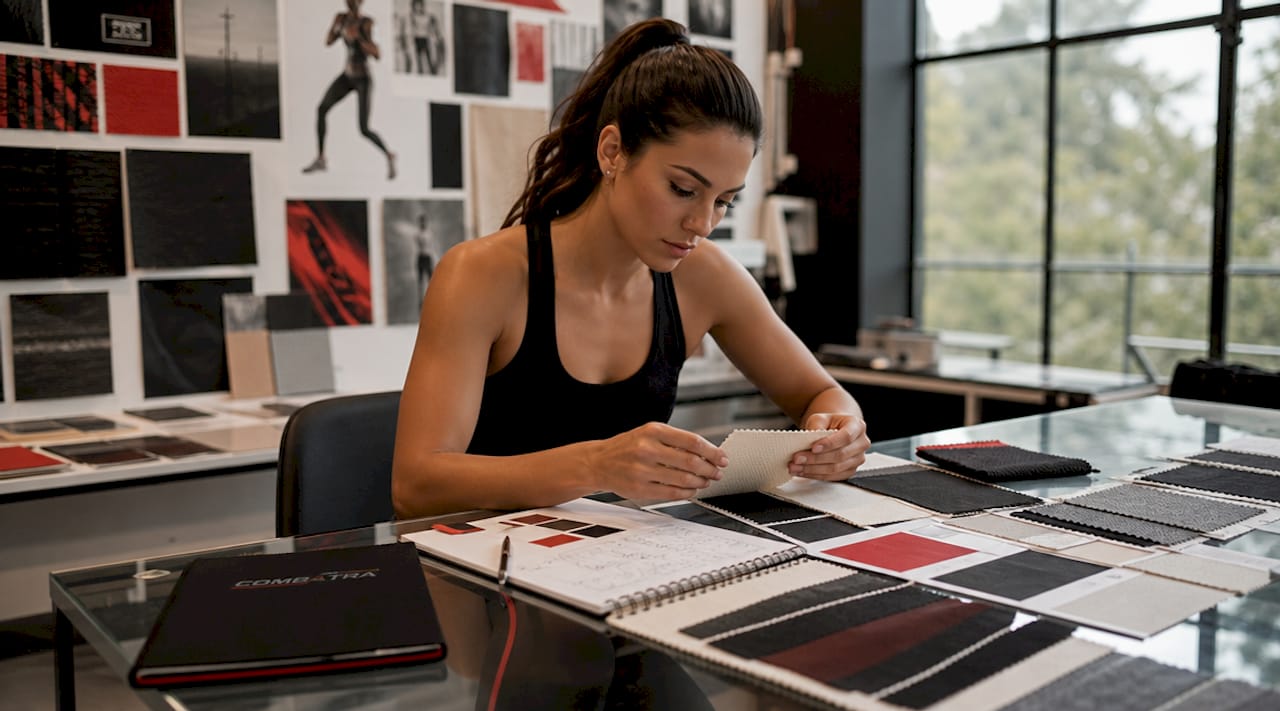
The foundation of any custom gi project is fabric selection. OEM manufacturers offer pearl weave cotton fabric across a GSM range of 350 to 550, with pants ripstop weights running from 8oz through to 12oz. Lighter jackets around 350 GSM suit warm climates and competitors watching weight, while heavier 550 GSM options offer greater durability for daily drilling. Matching jacket and pant materials for compatible shrinkage rates is critical. Mismatched fabrics can leave you with a jacket that fits perfectly but pants that have shrunk two sizes after the first wash.
Construction details that determine lifespan
Construction quality separates a gi that lasts six months from one that lasts six years. Triple-stitched seams, reinforced gussets, and reinforced knee and armpit panels are the three non-negotiable upgrades for any academy gi. These stress points take the most punishment during guard passing, takedowns, and collar grips. Contrast stitching in your academy colours is a simple way to add visual identity without adding a patch. Custom sizing options for men, women, and children mean every practitioner on your mat gets a gi that fits correctly, which directly reduces injury risk from loose fabric catching during rolls.
- Jacket GSM: 350 GSM for competition and warm climates; 450 to 550 GSM for durability-focused training gis
- Pants weight: 8oz ripstop for lightweight competition; 10oz to 12oz for training durability
- Seam construction: Triple-stitched seams at collar, shoulder, and armpit as standard
- Gusset placement: Reinforced crotch gusset and knee panels for ground-based training
- Sizing range: Bespoke sizing charts for men, women, and kids to cover your full academy
Pro Tip: Always request a pre-production sample in your most common size before approving a full run. Fabric shrinkage of 3 to 5 percent is normal for cotton pearl weave, and a sample lets you verify the fit after washing before committing to a full order.
What patch placement rules must your gi comply with?
Patch placement is where most academy gi projects run into trouble. The IBJJF specifies permitted patch zones as the shoulders, upper arms, chest, upper back below the collar, upper thighs, and the back and sides of the pants. These zones are not arbitrary. Placement restrictions exist primarily to prevent unfair grip advantages and safety risks during competition. Understanding this logic helps you design smarter, not just compliant.
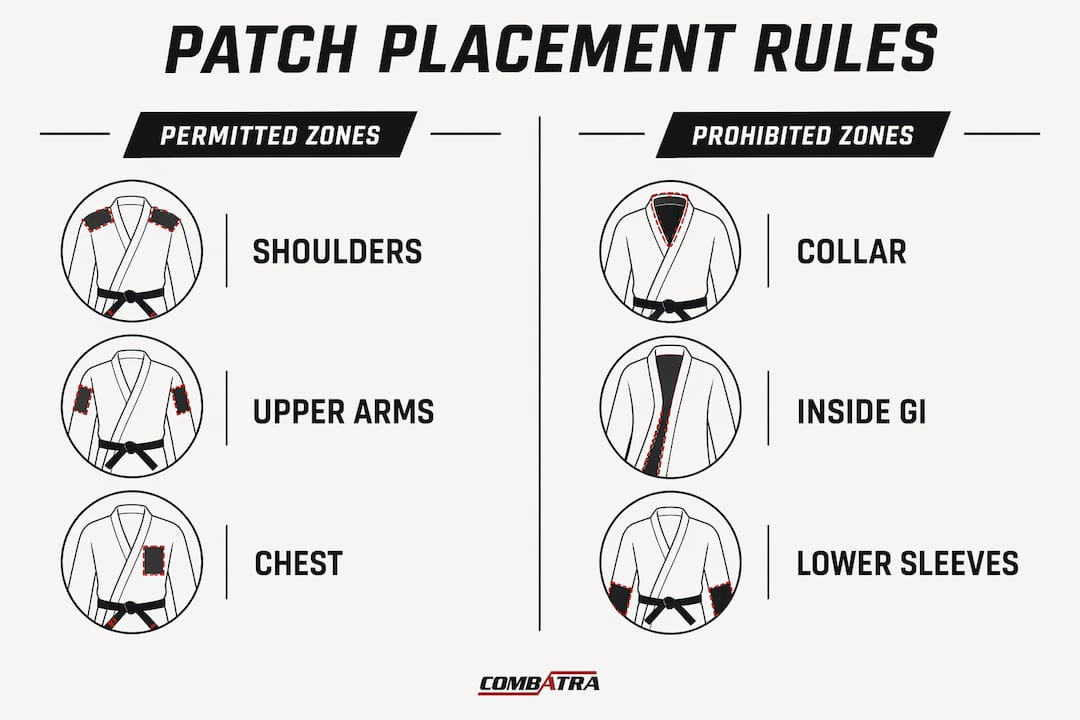
Prohibited zones are equally specific. Patches cannot appear on the collar, inside the gi, on sleeves below the shoulder, on the lower back, or within 15 cm of pant leg openings. The 2024 IBJJF updates brought one notable change: back-of-pants patches can now exceed 10 cm in width, whereas other pant areas retain their original size limits. This opens up more canvas for academy branding on the rear of the pants without risking a failed inspection.
| Zone | Permitted | Key size limit |
|---|---|---|
| Shoulders and upper arms | Yes | Standard patch dimensions |
| Chest | Yes | Standard patch dimensions |
| Upper back below collar | Yes | Standard patch dimensions |
| Back of pants | Yes | Width now exceeds 10 cm (2024 update) |
| Collar | No | Prohibited entirely |
| Within 15 cm of pant leg openings | No | Prohibited entirely |
| Lower back | No | Prohibited entirely |
Pro Tip: Design two separate artworks for every gi project. One version optimised for visual impact and brand messaging, and a second version adapted specifically to IBJJF-approved dimensions and patch zones. This two-step process prevents last-minute redesigns and inspection failures at tournaments.
Which patch style suits your academy logo best?
Choosing the right patch technology depends on your logo's complexity, the text size you need to reproduce, and the texture you want on the finished gi. The three main options are embroidered patches, woven patches, and dye-sublimated patches. Each has a distinct use case.
Embroidered patches deliver a bold, raised texture that reads well from a distance. They suit simple logos with clean lines and minimal fine detail. The limitation is that embroidery struggles with fine text below 8 to 10pt, which means small academy names or detailed crests will lose clarity. If your logo includes intricate linework or small lettering, embroidery is not the right choice.
Woven patches solve the fine detail problem. They sit lower profile on the gi fabric and allow much finer text resolution and sharper linework than embroidery can achieve. They are lighter and less bulky, which matters for competition gis where every gram counts. Dye-sublimated patches take a different approach entirely. They provide full-colour gradients and photographic-quality detail, making them ideal for academies with complex multi-colour logos or photo-based artwork. The trade-off is a smoother, flatter texture compared to the tactile quality of embroidery.
Regardless of which style you choose, sewn patches are required for competition gis. Iron-on adhesive fails under the friction and sweat of live rolling. Sewn patches use heavy-duty polyester thread with whip stitch and centre X reinforcement for security that survives repeated washing and competition use.
| Patch type | Best for | Limitation |
|---|---|---|
| Embroidered | Bold, simple logos | Cannot reproduce fine text or gradients |
| Woven | Detailed logos, small text | Less tactile texture than embroidery |
| Dye-sublimated | Complex multi-colour or photographic artwork | Flat texture, not raised |
Step-by-step process to order your academy's custom gi
A structured process prevents the most common and costly mistakes in custom gi production. Follow these steps to move from concept to finished product without surprises.
- Define your brand brief. Confirm your academy colours, logo files in vector format (AI or EPS), and any secondary graphics such as rank stripe colours or founding year text. Vector files are non-negotiable for clean patch reproduction at any size.
- Create two design versions. Develop one artwork file for visual appeal and a second adapted to IBJJF patch zones and size limits. This separation protects your creative vision while guaranteeing compliance.
- Select your fabric specifications. Choose jacket GSM, pants ripstop weight, stitching colour, and any reinforcement upgrades. Confirm sizing requirements across your full academy roster, including women's and children's sizes.
- Request digital mockups from your manufacturer. Reputable OEM services provide unlimited mockup revisions before production begins. Review every patch position, colour match, and size proportion carefully at this stage.
- Order a pre-production sample. Wash the sample twice before approving it. Check for shrinkage, colour fastness, and seam integrity under stress.
- Confirm minimum order quantities and lead times. Some OEM manufacturers accept minimum orders from 50 units, which makes custom gis accessible for smaller academies. Standard production and shipping typically runs 8 to 14 weeks, so plan well ahead of any season launch or tournament.
Common pitfalls to avoid during this process:
- Submitting raster image files (JPEG or PNG) instead of vector artwork, which causes blurry patch reproduction
- Ignoring fabric shrinkage when specifying sizes, resulting in gis that are too small after the first wash
- Rushing approval of digital mockups without checking patch dimensions against IBJJF rules
- Ordering a single size run without accounting for the full range of your academy's practitioners
Pro Tip: When reviewing your digital mockup, print it at actual scale and hold it against a real gi. Screen proportions are deceptive, and a patch that looks balanced on a monitor can appear oversized or undersized on the actual fabric.
Key takeaways
Designing a compliant and high-quality custom BJJ gi requires coordinating fabric selection, IBJJF patch compliance, patch technology, and a structured manufacturing process from the start.
| Point | Details |
|---|---|
| Fabric and construction first | Choose pearl weave GSM and ripstop weight based on climate and use, then specify reinforced seams. |
| Compliance before creativity | Map all patch placements against IBJJF permitted zones before finalising artwork. |
| Match patch style to logo complexity | Use woven patches for fine detail, embroidery for bold logos, and sublimation for photographic artwork. |
| Sewn patches only for competition | Iron-on adhesive fails under match conditions; sewn patches with polyester thread are required. |
| Plan for lead times | Custom gi production typically takes 8 to 14 weeks; order well ahead of your target launch date. |
Why the details matter more than the design
Most academy owners I speak with come to the custom gi process focused almost entirely on how the finished product will look. That instinct is understandable. A sharp-looking gi is a genuine marketing asset. It photographs well, it creates a sense of belonging, and it signals to prospective members that your academy takes itself seriously. But in my experience, the academies that end up disappointed with their custom gi order almost always made the same mistake. They treated compliance and construction as afterthoughts.
The IBJJF patch rules are not bureaucratic noise. They exist because patches in the wrong zones create grip advantages and safety hazards. An academy that shows up to a major tournament and has athletes fail gi inspection does not just lose competition time. It loses credibility. I have seen this happen to well-established academies that simply did not check the 2024 updates before reordering their existing design.
Bespoke sizing is the other area where the investment pays off in ways that are hard to quantify until you see it. When a 55 kg female practitioner trains in a gi that actually fits her body rather than a scaled-down men's A1, her movement improves, her confidence improves, and she is less likely to get injured from loose fabric. That outcome is worth far more than the marginal cost of adding women's and children's sizing to your order.
The academies that get the most value from custom gi programmes treat the design process as a team project. They involve senior students in colour and logo decisions, they photograph the finished product properly, and they use the launch as a marketing moment. A custom gi is not just a uniform. It is a statement about where your academy is headed.
— McGinnis
Design your academy gi with Combatra
Combatra specialises in fully custom BJJ gi design for academies of all sizes, from boutique schools to national competition teams. Every order includes free design mockups with unlimited revisions, bespoke sizing charts for men, women, and children, and full OEM customisation across fabric GSM, ripstop weight, stitching colour, patch style, and label design. Door-to-door shipping to Australia is included, with competitive pricing that makes professional-grade custom gis accessible without a large minimum commitment.
Whether you are launching your first academy uniform or refreshing an existing design, Combatra's team guides you through every step from artwork to delivery. Explore the full range of options including the custom plain black BJJ gi with custom shirt, designed specifically for academies that want a clean, professional look with flexible branding.
FAQ
What fabric weight is best for a custom BJJ gi?
Pearl weave cotton at 350 to 450 GSM suits competition and warm-climate training, while 500 to 550 GSM offers greater durability for daily drilling. Pants ripstop weight of 10oz is the most versatile choice for academy use.
How do I make sure my gi patches pass IBJJF inspection?
Place patches only in permitted zones including the shoulders, upper arms, chest, upper back below the collar, and approved pants areas. Avoid the collar, lower back, and within 15 cm of pant leg openings, and always use sewn rather than iron-on attachment.
What is the minimum order quantity for custom gis?
Some OEM manufacturers accept minimum orders from 50 units, making custom gis practical for smaller academies. Confirm minimum quantities and lead times of 8 to 14 weeks with your manufacturer before committing.
Which patch type is best for a detailed academy logo?
Woven patches reproduce fine text and intricate linework more clearly than embroidery. For complex multi-colour logos or photographic artwork, dye-sublimated patches provide the sharpest and most vivid result.
Can I get custom sizing for women and children in the same order?
Yes. Reputable OEM manufacturers provide bespoke sizing charts covering men's, women's, and children's cuts within a single production run, allowing your entire academy to train in correctly fitted gis.