
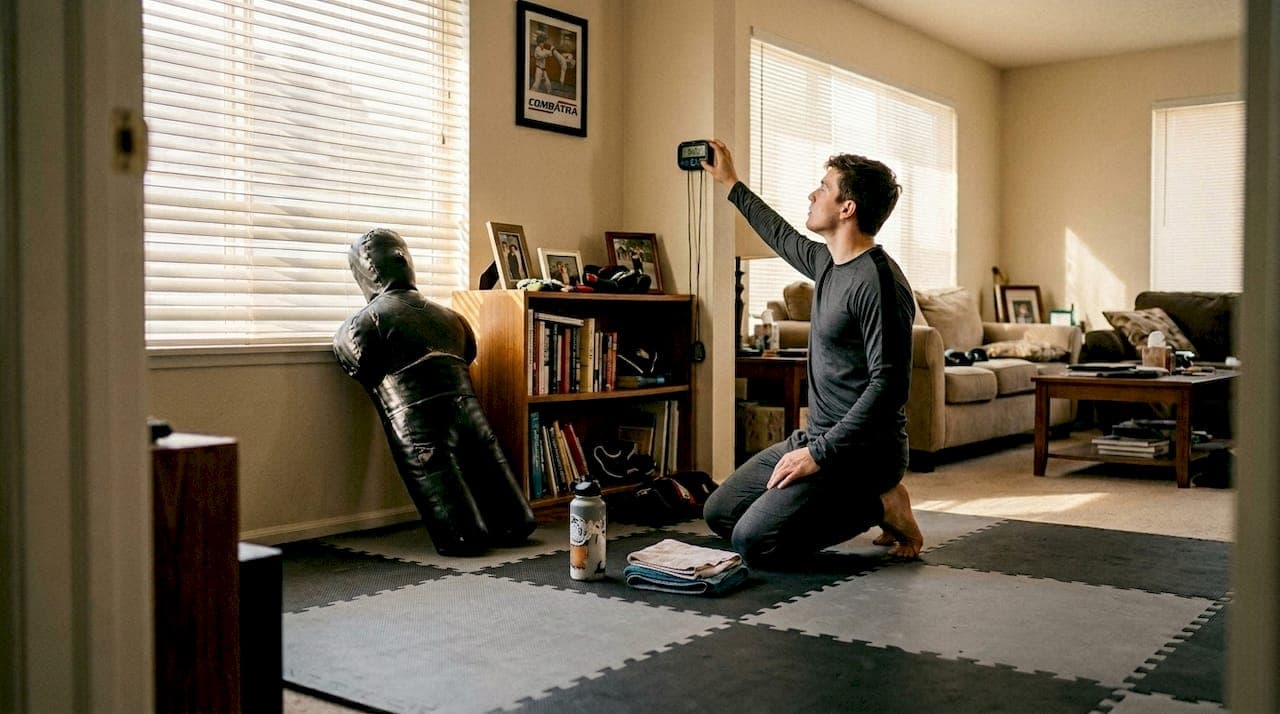
Building an effective home training space for Brazilian Jiu-Jitsu can feel overwhelming when you're just starting out. Between grappling dummies, resistance bands, timers, and foam mats, new practitioners often struggle to identify which tools deliver real training value versus those that collect dust in the corner. The right equipment transforms your living room into a productive training zone where you can drill techniques, build conditioning, and reinforce what you learn in class. This guide cuts through the noise to highlight the essential gear that actually improves your skills and prepares you for live rolling.
Table of Contents
- Key takeaways
- How to choose essential home BJJ training equipment
- Interval timers and protective foam mats
- Grip strength trainers and grappling dummies
- Using a BJJ training journal to track progress
- Enhance your BJJ training with Combatra gear
- Essential home BJJ training equipment for beginners FAQs
Key Takeaways
| Point | Details |
|---|---|
| Interval timer essential | An interval timer structures rounds and rest periods to simulate gym sessions and keep conditioning focused. |
| Protective foam mats | Foam mats protect joints during ground work to reduce impact during solo grappling drills. |
| Grip endurance training | Progressive grip work improves grip endurance and control for gi grips and wrist control in no gi situations. |
| Grappling dummy or journal | Grappling dummy enables positional drilling without a partner or a journal helps retain and review techniques. |
How to choose essential home BJJ training equipment
Building a home training system starts with understanding what replicates gym conditions without requiring a training partner. Prioritize a system over gear accumulation: timer plus mats plus bands or grips plus dummy or journal enable repeatable solo sessions enhancing gym performance. This approach prevents the common beginner mistake of buying random equipment that sits unused because it doesn't fit into a cohesive practice routine.
Quality and stability matter significantly more than quantity. A wobbly grappling dummy that tips over during drills wastes your time and builds frustration instead of skill. An unreliable timer that skips intervals disrupts your conditioning flow. Start with foundational pieces that create a safe, structured environment, then add specialized tools as your training demands evolve.
Progressive overload with grip trainers builds endurance specific to BJJ gripping patterns. Unlike general strength training, these tools target the crushing grip needed to control an opponent's gi or maintain wrist control in no-gi situations. Whether you're exploring starting gi or no-gi BJJ, grip strength translates directly to mat performance.
Your home setup should enable three core training modes: timed conditioning circuits, technical drilling on mats, and strength building through resistance work. Each piece of equipment serves one or more of these functions. A minimal but effective system includes:
- An interval timer to structure rounds and rest periods
- Protective foam mats for joint safety during ground work
- Grip trainers or resistance bands for strength building
- Either a grappling dummy for positional drilling or a journal for technique retention
Pro Tip: Start with just a timer and mats for your first month of home training. Master solo movement drills and conditioning circuits before investing in a grappling dummy. This approach builds your training discipline while you determine which additional tools match your specific goals.
Interval timers and protective foam mats
An interval training timer is essential for structuring solo BJJ rounds, conditioning circuits, and drills at home, simulating gym sessions. Without structured timing, home workouts drift into unfocused movement that doesn't build the cardiovascular base needed for five-minute competition rounds. Digital timers with adjustable work and rest intervals let you customize training to match your current fitness level.
Three timer types serve different training styles. Digital wall-mounted timers offer large displays visible across your training space, perfect for high-intensity circuits where you're moving constantly. App-based timers on your phone provide flexibility and custom interval programming, though smaller screens can be harder to see mid-drill. Dedicated gym timers with loud buzzers cut through heavy breathing and background noise during intense sessions.
Adjustable intervals matter because beginner conditioning differs dramatically from advanced athlete capacity. Start with 2-minute work periods and 1-minute rest, gradually extending to the standard 5-minute rounds with 1-minute breaks as your endurance improves. Quality timers let you program multiple rounds with automatic progression, eliminating the need to constantly reset between sets.
Folding or interlocking puzzle mats with 3/4 inch thick EVA foam protect joints during drilling, mobility work, and grappling dummy use. Hard floors destroy your knees during shrimping drills and make hip escapes painful instead of productive. Proper mats absorb impact during throws and takedown entries, letting you practice techniques at full speed without injury risk.
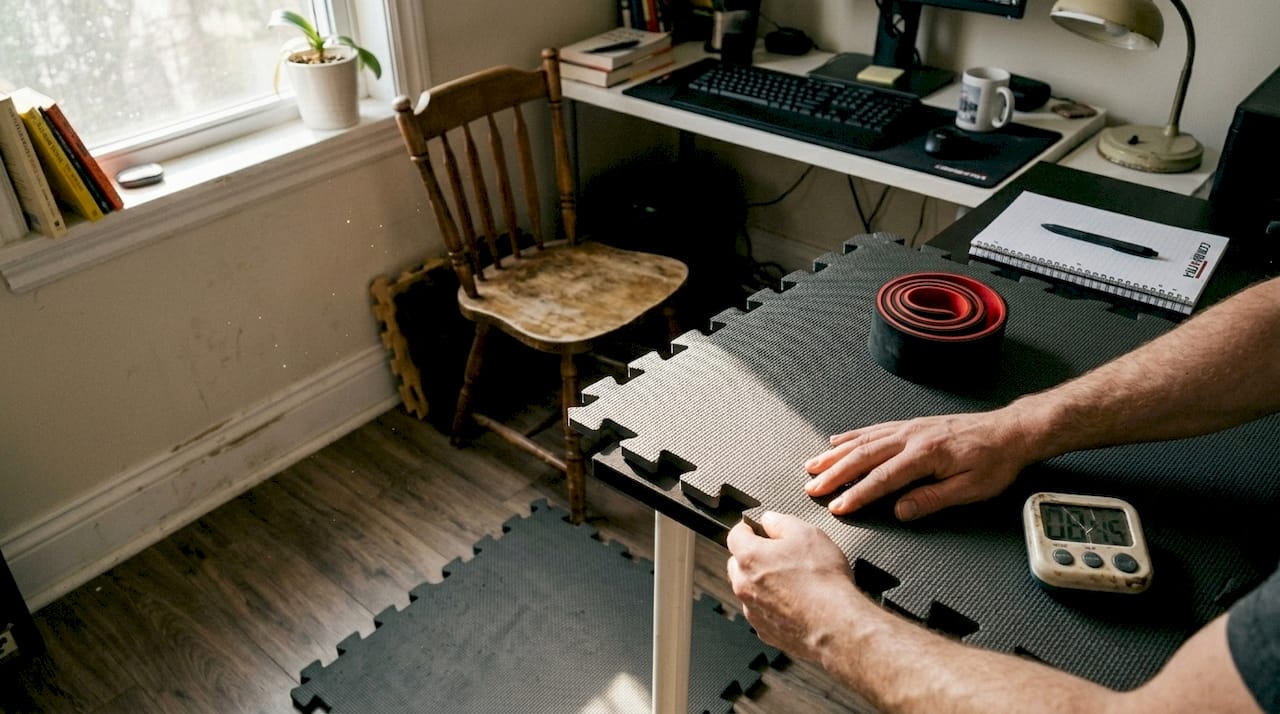
Mat selection depends on your available space and storage needs. Interlocking puzzle mats snap together to cover large areas and disassemble for compact storage, ideal for shared living spaces. Folding mats offer quicker setup with fewer seams but require more storage room. Both styles provide the shock absorption necessary for safe solo drilling.
Coverage area matters more than you might expect. A 6x6 foot space works for stationary drills, but 8x8 or larger lets you practice movement-based techniques like guard retention and scrambles. When using a grappling dummy, extra mat space prevents you from rolling off onto hard floor mid-drill. Consider your primary training focus when sizing your mat investment.
Pro Tip: Place your mats in a permanent training spot if possible. The setup friction of constantly moving and reassembling mats kills training consistency. Even a small dedicated corner with BJJ gi pants hanging nearby creates a psychological trigger that makes starting your session easier.
Grip strength trainers and grappling dummies
Grip strength trainers like adjustable hand grippers with resistance from 26 to 181 lbs and resistance bands build gi and no-gi endurance, crush grip, and translate to mat control. Your hands give out long before your technique fails during live rolling, especially in the gi where maintaining sleeve and collar grips determines position dominance. Progressive resistance training addresses this limiting factor directly.
Adjustable hand grippers offer the most versatile grip training because you can increase resistance as your strength improves without buying multiple tools. Start at 26 to 50 lbs if you're new to grip training, focusing on high-rep sets that build endurance rather than maximum strength. Move up in 20 lb increments as you can complete 3 sets of 15 reps per hand with good form.
Resistance bands complement grip training while assisting with hip and knee mobility and injury prevention. Loop bands around your feet for ankle flexibility work, wrap them around your knees for hip abduction strengthening, or use them for shoulder mobility drills that protect against common BJJ injuries. The versatility makes bands one of the highest-value additions to any home training setup.
A grappling dummy enables technique reps like top control transitions, pressure passing, and submissions without a partner, with stable 85 lb models preferred over lighter ones to minimize resets. Weight distribution creates realistic resistance that lighter dummies can't replicate. An 85 lb dummy stays in position during arm bar setups and doesn't flop over when you're working on maintaining side control pressure.
| Dummy weight | Stability rating | Best use case | Reset frequency |
|---|---|---|---|
| 40-50 lbs | Low | Light drilling only | Every 2-3 reps |
| 60-70 lbs | Medium | Submission practice | Every 5-7 reps |
| 85+ lbs | High | Positional drilling | Every 10+ reps |
| 100+ lbs | Very high | Pressure training | Minimal resets |
Lighter dummies frustrate beginners because they require constant repositioning that breaks training flow and reduces effective rep volume. You spend more time fighting the dummy's instability than practicing actual technique. The upfront cost difference between a 50 lb and 85 lb dummy pays for itself in training quality within the first month.
Grip strength and solo drilling with a dummy build mat control and confidence that translates immediately to live rolling. When your hands don't fatigue in the first two minutes of a round, you can focus on technique execution instead of just surviving. When you've drilled 100 arm bar reps on a dummy, the movement pattern becomes automatic during sparring.
Pro Tip: Focus dummy work on positions you struggle with during live training. If you get swept from side control constantly, spend 10 minutes daily drilling base maintenance and pressure distribution on the dummy. Targeted repetition fixes specific weaknesses faster than random technique practice.
"The grappling dummy transformed my home training from random movement to focused skill building. I can drill the same pass 50 times in a row, something impossible even with the most patient training partner." - Experienced home training practitioner
Pair your equipment with quality training gear like Combatra BJJ belts that track your progression from white through colored ranks as your skills develop.
Using a BJJ training journal to track progress
A BJJ training journal tracks progress, retains techniques, and identifies issues between sessions. The volume of information thrown at beginners during class overwhelms memory capacity. You learn a sweep on Tuesday, drill it Wednesday, then completely forget the setup details by the following week. Written records solve this retention problem.
Journals help retain complex techniques learned during sessions by forcing you to articulate the mechanical details in your own words. Writing "grab the collar with four fingers inside, thumb outside, pull down toward their opposite hip while stepping my right foot to their left hip" creates a memory anchor that "do the collar choke" never will. The act of writing encodes the information more deeply than passive review.
Tracking drills and conditioning highlights strengths and weaknesses you might not notice during training. When you log that you completed 8 rounds of positional sparring from bottom side control and got swept 6 times, the pattern becomes obvious. You need more work on frames and creating space. Without written records, these patterns hide in the blur of weekly training.
Written records motivate consistency and goal setting by creating visible progress markers. Flipping back three months to see you could barely complete 3 rounds of solo drilling versus your current 8-round capacity provides concrete evidence of improvement. Set specific goals like "drill 100 hip escapes without stopping" and track your progress toward that benchmark.
Your journal can include notes on soreness and injury prevention that help you identify overtraining patterns before they become serious problems. If your right shoulder hurts every Thursday, look back at your Wednesday training log. Maybe you're overloading that arm during specific drills. Adjust your training volume or technique execution based on these insights.
Journal entries don't need to be lengthy essays. Effective logs include:
- Date and training duration
- Techniques learned or drilled
- Sparring rounds completed and outcomes
- Physical condition notes (energy level, soreness, injuries)
- One specific thing to focus on next session
This structure takes 5 minutes after training and provides all the information needed to track progress and plan future sessions. Digital notes apps work fine, but many practitioners prefer physical notebooks that live with their training gear as a consistent visual reminder.
Journaling supports mental and strategic growth alongside physical training. You begin recognizing which techniques fit your body type and which require too much flexibility or strength for your current level. You identify training partners whose styles expose your weaknesses most effectively. These insights accelerate improvement far beyond what random training provides.
Pro Tip: Review your journal every Sunday to plan the coming week's training focus. If your notes show you've been neglecting guard retention drills, prioritize those in your next three home sessions. This weekly review habit transforms scattered training into a progressive skill-building system.
Complement your training documentation with premium BJJ belts that mark your formal rank progression as your journal tracks the daily details of your improvement.
Enhance your BJJ training with Combatra gear
Once you've established your home training routine with the right equipment, quality training apparel makes every session more comfortable and effective. Combatra specializes in personalized BJJ and MMA gear designed for serious practitioners who demand durability and performance from their training clothes.

Discover customizable MMA fight shorts built for the demands of grappling training, with reinforced stitching that withstands constant friction and movement. The moisture-wicking fabric keeps you comfortable during intense conditioning circuits on your home mats.
Build custom rashguard compression tops tailored to your style, with options for personalized names, logos, and colors that make your training gear uniquely yours. Compression fit supports muscle recovery while providing a smooth surface that won't catch during drilling.
Explore the full range of Combatra combat sports gear ideal for BJJ practitioners at any level, from beginner essentials to competition-ready equipment. Quality gear supports consistent training by eliminating discomfort and equipment failures that disrupt your practice flow.
Essential home BJJ training equipment for beginners FAQs
What is the most important equipment for starting BJJ at home?
An interval timer and protective foam mats form the essential foundation for home BJJ training. The timer structures your conditioning work and drills to match gym session intensity, while mats protect your joints during ground work and solo drilling. These two items enable productive training immediately without requiring expensive specialized equipment.
How heavy should my grappling dummy be for effective training?
An 85 lb grappling dummy provides the best balance of stability and realistic resistance for most beginners. Lighter dummies under 60 lbs tip over constantly during positional drilling, forcing you to reset repeatedly and breaking your training flow. Heavier models stay in position during submissions and transitions, letting you complete high-rep sets without interruption.
Can I build grip strength effectively without a gym?
Adjustable hand grippers with progressive resistance from 26 to 181 lbs build BJJ-specific grip strength more effectively than most gym equipment. Combined with resistance bands for forearm and wrist mobility work, home grip training develops the crushing power and endurance needed for gi control and no-gi wrist fighting. Consistent daily practice with these simple tools produces noticeable mat performance improvements within 4 to 6 weeks.
Do I need special mats for BJJ drilling?
Standard 3/4 inch thick EVA foam mats are essential for safe solo BJJ drilling at home. Hard floors cause knee and elbow injuries during shrimping, hip escapes, and other fundamental movements that form the foundation of ground work. Quality mats also provide the stable surface needed when using a grappling dummy or practicing takedown entries.
How often should I update my training journal?
Log your training immediately after each session while details are fresh, ideally within 10 minutes of finishing your workout. This timing captures specific technique details and performance observations before they fade from memory. Review your journal weekly to identify patterns and plan upcoming training focus areas, creating a feedback loop that accelerates skill development.
Can resistance bands replace grip trainers for BJJ?
Resistance bands complement grip trainers but don't fully replace them for building crushing grip strength. Bands excel at mobility work, injury prevention, and dynamic resistance training, while adjustable hand grippers provide the progressive overload needed to develop maximum grip endurance. An effective home training setup includes both tools serving different but equally important functions.